
Pythagorean Theorem Demonstration by PopiArdv
Loading the math board and drawing, please wait…
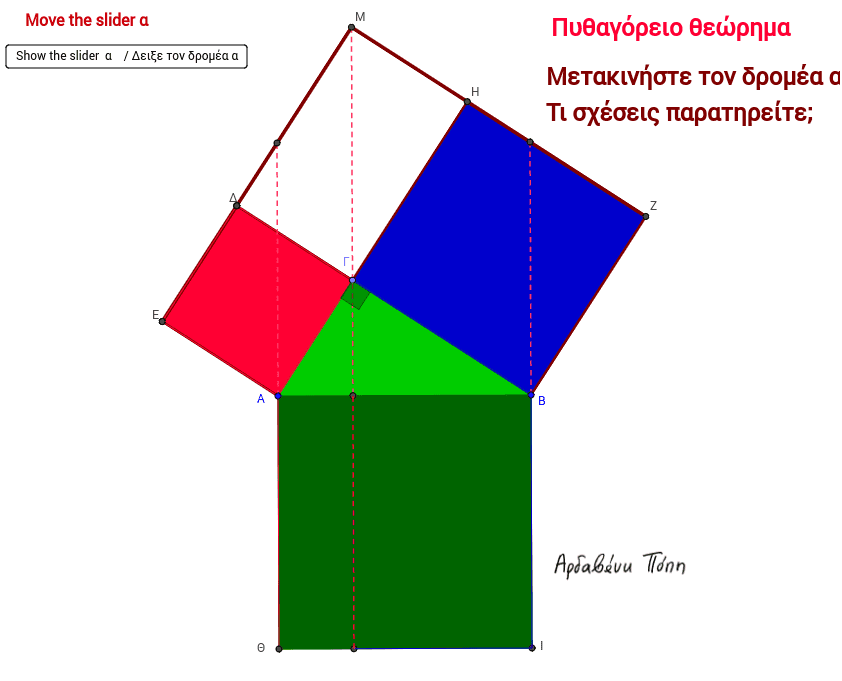
This example visually demonstrates the Pythagorean theorem in right-angled triangles, illustrating the relationship between the lengths of the three sides. Key math concepts include the Pythagorean theorem, right triangles, and analytical geometry. It utilizes GeoGebra commands and objects such as Polygon, OrthogonalLine, Semicircle, Point, Ray, Intersect, Segment, Circle, Line, and Angle. Suitable for middle school students and above to learn and understand the theorem and its applications.
GeoGebra Commands & Parameters
Polygon(Β, Α, 4) → πολύγ4, k, l, m, n, Θ, ΙOrthogonalLine(Β, k) → sSemicircle(Α, Β) → cPoint(c) → ΓPolygon(Γ, Β, 4) → πολύγ3, g, h, i, j, Ζ, ΗRay(Ζ, Η) → qPolygon(Α, Γ, 4) → πολύγ2, b, d, e, f, Δ, ΕRay(Ε, Δ) → pIntersect(p, q) → ΜSegment(Μ, Ζ) → e_1Segment(Α, Β) → aPolygon(Γ, Α, Β) → πολύγ1, β_1, γ, α_1OrthogonalLine(Α, k) → rIntersect(r, p) → ΚSegment(Α, Κ) → tIntersect(s, e_1) → ΛSegment(Λ, Β) → a_1OrthogonalLine(Μ, k) → b_1Intersect(b_1, k) → ΝSegment(Μ, Ν) → c_1Segment(Μ, Ε) → d_1Segment(Ν, Α) → f_1Segment(Ν, Β) → g_1Circle(Γ, v) → h_1Intersect(h_1, c_1) → Ξ, ΟCircle(Δ, δ) → k_1Intersect(k_1, d_1) → Π, ΡCircle(Ν, w) → p_1Line(Γ, Μ) → i_1Intersect(p_1, i_1, 1) → ΣCircle(Π, b) → q_1Intersect(e, d_1) → ΥIntersect(q_1, d_1) → Φ, ΧPolygon(Χ, Α, Γ, Π) → πολύγ5, χ, α_2, γ_1, πCircle(Ο, k) → r_1Intersect(i_1, c_1) → ΨIntersect(r_1, i_1) → Ω, Α_1Polygon(Κ, Α_1, Ο, Α) → πολύγ6, κ, α_3, ο, α_4OrthogonalLine(Σ, l) → j_1Intersect(j_1, l) → Β_1Circle(Σ, k) → s_1Intersect(i_1, c_1) → Γ_1Intersect(i_1, c_1) → Δ_1Intersect(i_1, c_1) → Ε_1Intersect(i_1, c_1) → Ζ_1Intersect(i_1, c_1) → Η_1Intersect(i_1, c_1) → Θ_1Intersect(i_1, c_1) → Ι_1Intersect(s_1, i_1) → Κ_1, Λ_1OrthogonalLine(Λ_1, t) → l_1Intersect(t, α_4) → Ο_1Intersect(l_1, t) → Π_1Polygon(Π_1, Λ_1, Σ, Β_1) → πολύγ7, π_1, λ_1, σ, β_2Intersect(i_1, λ_1) → Μ_1Intersect(m, i_1) → Ν_1Polygon(Α, Ν, Ν_1, Θ) → πολύγ8, α_5, ν, ν_1, θCircle(Γ, ζ) → d_2Intersect(d_2, c_1) → Υ_1, Φ_1Circle(Φ_1, k) → f_2Intersect(f_2, c_1, 1) → Χ_1Polygon(Λ, Χ_1, Φ_1, Β) → πολύγ10, λ, χ_1, φ_1, β_4Ray(Μ, Ζ) → m_1Circle(Ν, z) → g_2Ray(Γ, Ν) → n_1Intersect(m, n_1) → Σ_1Intersect(g_2, n_1) → Ψ_1, Ω_1OrthogonalLine(Ω_1, n_1) → a_2Circle(Ω_1, k) → h_2Intersect(h_2, c_1) → Β_2,OrthogonalLine(Β_2, t) → b_2Intersect(b_2, a_1) → Γ_2Intersect(n, a_2) → Δ_2Polygon(Β_2, Γ_2, Δ_2, Ω_1) → πολύγ11, β_5, γ_3, δ_2, ω_1Circle(Η, ε) → t_1Ray(Η, Μ) → c_2Intersect(t_1, e_1) → Τ_1, ΤAngle(Α, Γ, Β) → βPolygon(Ν, Β, Ι, Ν_1) → πολύγ12, ν_2, β_6, ι, ν_3Circle(Τ_1, g) → k_2Intersect(k_2, m_1) → Ρ_1, Α_2Point(β_6) → Ε_2Polygon(Τ_1, Α_2, Β, Γ) → πολύγ9, τ_1, α_6, β_3, γ_2
AI Drawing Prompt Reference
Draw a right triangle to demonstrate the Pythagorean theorem, using a semicircle and squares to illustrate the relationship between the lengths of the three sides. Start by drawing the right triangle, then draw a semicircle with the hypotenuse as the diameter. Construct squares on each side of the triangle and compare their areas. Add auxiliary lines, circles, and intersection points to clearly show the geometric proof of the theorem.
The prompt above was compiled from the original drawing commands and is for reference only.