
Pythagorean Theorem Demonstration by Mary Anne Ward
Loading the math board and drawing, please wait…
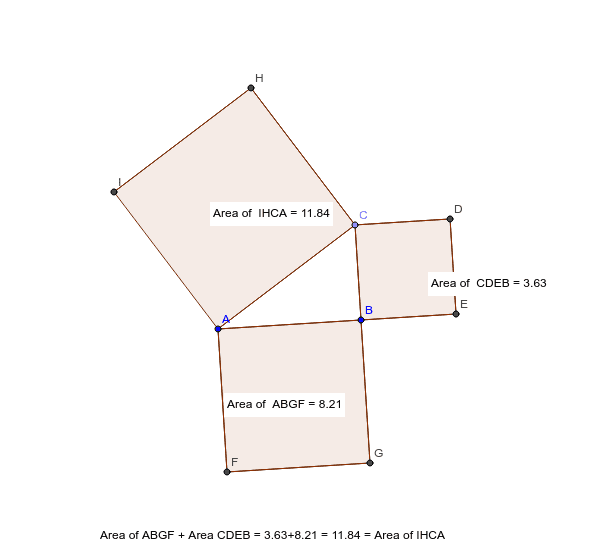
This applet demonstrates the Pythagorean Theorem, which states that in a right-angled triangle, the square of the length of the hypotenuse (the side opposite the right angle) is equal to the sum of the squares of the lengths of the other two sides. Key concepts include right-angled triangles and the Pythagorean Theorem. Using GeoGebra commands such as Segment, OrthogonalLine, and Circle, the applet dynamically shows the relationship between the sides of a right-angled triangle. Suitable for middle school and above students learning geometry and trigonometry.
GeoGebra Commands & Parameters
Segment(A, B) → aOrthogonalLine(B, a) → bPoint(b) → CSegment(C, A) → cSegment(C, B) → dCircle(C, B) → eOrthogonalLine(C, d) → fIntersect(e, f, 2) → DSegment(D, C) → gOrthogonalLine(B, d) → hOrthogonalLine(D, g) → iIntersect(h, i) → ESegment(E, B) → jSegment(E, D) → kPolygon(C, D, E, B) → poly1, c_1, d_1, e_1, b_1PointIn(poly1) → Pointpoly1Circle(A, B) → pOrthogonalLine(A, a) → lIntersect(p, l, 1) → FCircle(B, A) → qOrthogonalLine(B, a) → mIntersect(q, m, 1) → GOrthogonalLine(G, m) → nLine(A, F) → rSegment(A, F) → sSegment(F, G) → tSegment(G, B) → a_1Polygon(A, B, G, F) → poly2, a_2, b_2, g_1, f_1PointIn(poly2) → Pointpoly2Circle(C, A) → h_1Circle(A, C) → k_1OrthogonalLine(C, c) → i_1OrthogonalLine(A, c) → j_1Intersect(h_1, i_1, 1) → HIntersect(k_1, j_1, 1) → ISegment(I, H) → l_1Segment(H, C) → m_1Polygon(I, H, C, A) → poly3, i_2, h_2, c_2, a_3PointIn(poly3) → Pointpoly3_1PointIn(poly3) → Pointpoly3
AI Drawing Prompt Reference
Draw a right-angled triangle, label the hypotenuse and the two legs, and draw three squares on each side. Dynamically demonstrate that the area of the square on the hypotenuse equals the sum of the areas of the squares on the other two sides, using auxiliary lines and circles to verify the Pythagorean theorem through coordinate geometry and trigonometry.
The prompt above was compiled from the original drawing commands and is for reference only.