
Pythagorean Theorem Demonstration by Duane Habecker
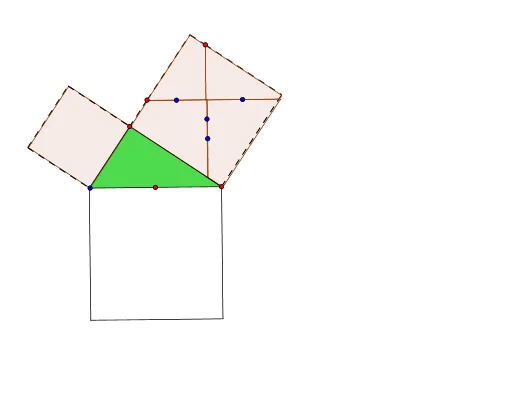
Loading the math board and drawing, please wait…
This example dynamically demonstrates the Pythagorean theorem by visualizing the relationship between the sides of a right triangle, providing an interactive proof of the theorem. Key math concepts include Pythagorean theorem, right triangles, and distance calculations. Construction involves commands like Circle, Line, Intersect, Point, Segment, Rotate, OrthogonalLine, Polygon for geometric visualization and verification. Suitable for middle school students and math enthusiasts exploring geometric proofs and concepts.
GeoGebra Commands & Parameters
Circle(A, B) → c_1Line(B, A) → c_2Intersect(c_1, c_2, 2) → CPoint(c_1) → DSegment(C, D) → aSegment(D, B) → bRotate(D, 90°, C) → ERotate(C, 90°, E) → FRotate(B, 90°, D) → GRotate(D, 90°, G) → HRotate(C, 90°, B) → IRotate(B, 90°, I) → JSegment(C, B) → cOrthogonalLine(G, c) → dOrthogonalLine(B, c) → eSegment(G, H) → fIntersect(e, f) → KSegment(G, K) → gPoint(g) → LLine(H, c) → hLine(D, c) → iSegment(D, G) → jSegment(B, H) → kIntersect(h, j) → MSegment(D, M) → lPoint(l) → NSegment(G, H) → mOrthogonalLine(L, c) → nLine(N, c) → pIntersect(n, p) → OIntersect(b, n) → PIntersect(k, p) → QSegment(L, H) → qSegment(L, O) → rSegment(O, Q) → sSegment(Q, H) → tCircle(R, (0.5 * s)) → c1Line(R, s) → a1Intersect(c1, a1, 1) → SIntersect(c1, a1, 2) → TCircle(S, r) → d1OrthogonalLine(S, a1) → b1Intersect(d1, b1, 2) → UCircle(U, q) → e1Circle(T, t) → f1Intersect(e1, f1, 1) → VSegment(N, O) → g1Segment(N, G) → h1Segment(G, L) → i1Circle(W, (0.5 * g1)) → k1Line(W, g1) → j1Intersect(k1, j1, 1) → ZIntersect(k1, j1, 2) → A1Circle(A1, r) → p1OrthogonalLine(A1, j1) → l1Intersect(p1, l1, 2) → B1Circle(Z, h1) → q1Circle(B1, i1) → r1Intersect(q1, r1, 1) → C1Segment(N, D) → m1Segment(D, P) → n1Segment(P, O) → s1Circle(D1, (0.25 * s1)) → t1Line(D1, s1) → a2Intersect(t1, a2, 2) → E1OrthogonalLine(E1, a2) → b2Circle(E1, s1) → c2Intersect(c2, a2, 1) → F1Circle(E1, g1) → d2Intersect(d2, b2, 2) → G1Circle(G1, m1) → e2Circle(F1, n1) → f2Intersect(e2, f2, 2) → H1Segment(P, B) → g2Segment(B, Q) → h2Circle(I1, (0.5 * s1)) → k2Line(I1, s1) → i2Intersect(k2, i2, 2) → J1Intersect(k2, i2, 1) → K1OrthogonalLine(J1, i2) → j2Circle(J1, s) → p2Intersect(p2, j2, 1) → L1Circle(L1, h2) → q2Circle(K1, g2) → r2Intersect(q2, r2, 1) → M1Polygon(Z, A1, B1, C1) → poly1, z, a1_1, b1_1, c1_1Polygon(J1, K1, M1, L1) → poly2, j1_1, k1_1, m1_1, l1_1Polygon(U, S, T, V) → poly3, u, s_1, t_1, vPolygon(G1, H1, F1, E1) → poly4, g1_1, h1_1, f1_1, e1_1Segment(E, F) → l2Circle(N1, a) → s2Line(N1, a) → m2Intersect(s2, m2, 2) → O1OrthogonalLine(O1, m2) → n2OrthogonalLine(N1, m2) → t2Intersect(s2, t2, 2) → P1Circle(O1, a) → c3Intersect(c3, n2, 2) → Q1Polygon(N1, O1, Q1, P1) → poly5, n1_1, o1, q1_1, p1_1Segment(E, C) → a3Segment(F, D) → b3Segment(C, J) → d3Segment(J, I) → e3Segment(I, B) → f3Polygon(D, C, B) → poly6, b_1, d_1, c_3