
Pythagoras' Theorem: Euclid's Proof
Loading the math board and drawing, please wait…
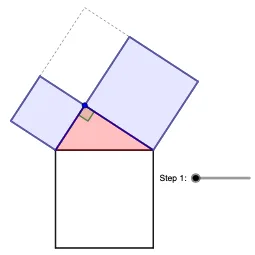
This example demonstrates Euclid's geometric proof of the Pythagorean Theorem by constructing a right triangle and related shapes to illustrate the theorem's validity. Core mathematical concepts include the Pythagorean Theorem, geometric construction, area relationships, and right triangles. It uses commands/objects like Circle, Point, Polygon, Angle, Line, Intersect, and Segment in GeoGebra. Suitable for high school mathematics teaching or for math enthusiasts studying geometric proofs.
GeoGebra Commands & Parameters
Circle(O, B) → circlePoint(circle) → CPolygon(A, B, C) → t1, c, a, bAngle(A, C, B) → αPolygon(A, C, 4) → poly1, f, g, h, i, D, EPolygon(C, B, 4) → poly2, j, k, l, m, F, GPolygon(B, A, 4) → poly3, n, p, q, r, H, ILine(E, D) → sLine(G, F) → tIntersect(s, t) → JSegment(D, J) → Segment_{DJ}Segment(J, G) → Segment_{GJ}Circle(F, (e * Segment_{GJ})) → d_1Circle(E, (e * Segment_{DJ})) → c_1Intersect(Segment_{DJ}, Segment_{GJ}) → KLine(E, K) → dIntersect(c_1, d) → L, ParaLeftTLLine(F, K) → f_1Intersect(d_1, f_1) → M, ParaRightTopRightCircle(ParaRightTopRight, a) → e_1Intersect(e_1, f_1) → P, ParaRightTopLeftPolygon(ParaRightTopLeft, C, B, ParaRightTopRight) → q1, ParaRightLeft, c_2, ParaRightRight, ParaRightTopCircle(ParaLeftTL, b) → g_1Intersect(g_1, d) → R, ParaLeftTRPolygon(C, ParaLeftTR, ParaLeftTL, A) → q2, ParaLeftRight, ParaLeftTop, ParaLeftLeft, a_1Circle(B, (o * c)) → h_1Intersect(h_1, r) → T,Circle(C, (o * c)) → k_1Line(J, C) → i_1Intersect(k_1, i_1, 2) → UCircle(A, (o * c)) → p_1Intersect(p_1, p) → V,Circle(T, c) → r_1Intersect(r_1, ParaRightRight) → W,Circle(U, c) → t_1Intersect(t_1, i_1) → Z, A_1Intersect(ParaLeftLeft, a_1) → B_1Circle(V, c) → d_2Intersect(d_2, ParaLeftLeft) → C_1,Polygon(V, C_1, Z, W, T, U) → poly4, HexLeft, HexTopLeft, HexTopRight, HexRight, HexBottomRight, HexBottomLeftPolygon(C_1, V, U, T, W) → poly5, c_5, v_2, u_2, t_4, w_1Segment(ParaLeftTL, ParaLeftTR) → ParaLeftTopDarkSegment(ParaRightTopLeft, ParaRightTopRight) → ParaRightTopDarkCircle(A, (u * c)) → q_1Circle(B, (u * c)) → s_1Circle(C, (u * c)) → e_2Intersect(HexLeft, c_5) → NIntersect(HexLeft, c_5) → QIntersect(j_1, q1) → SIntersect(q_1, j_1) → D_1, E_1Intersect(e_2, i_1) → F_1, G_1Intersect(s_1, l_1) → H_1, I_1Polygon(E_1, G_1, I_1) → t2, i_2, e_3, g_2
AI Drawing Prompt Reference
Draw a right triangle and circle the right angle vertex to intersect the hypotenuse. Connect these intersection points to the right angle vertex, forming three smaller triangles. Circle the vertices of these triangles, intersecting to create points and connecting them into hexagons and other polygons, illustrating the geometric proof of the Pythagorean theorem.
The prompt above was compiled from the original drawing commands and is for reference only.