
Pythagoras Theorem Demonstration by GreenMaths
Loading the math board and drawing, please wait…
In collections
Pythagoras
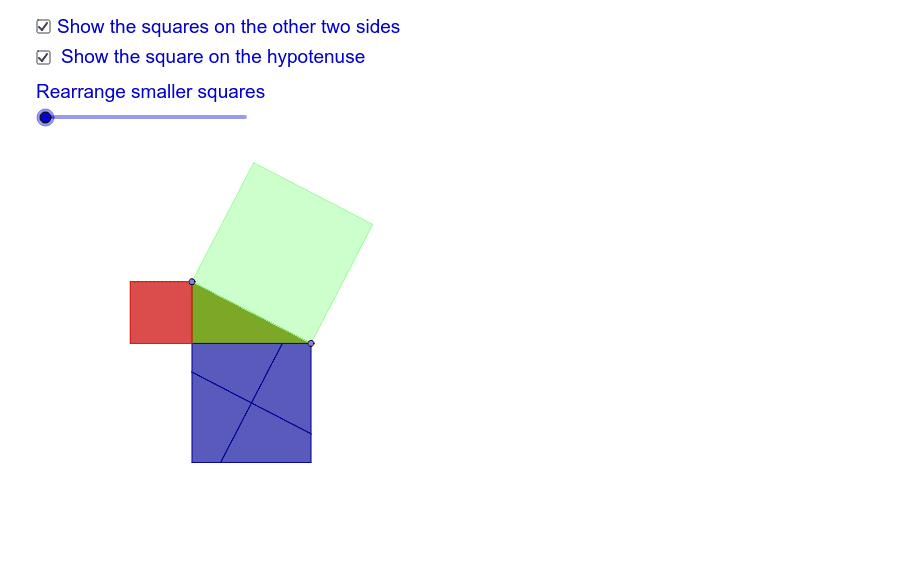
This example demonstrates Pythagoras' theorem by constructing the relationship between the sides of a right triangle. Key mathematical concepts include right triangles and the Pythagorean theorem. The construction involves using GeoGebra commands such as Segment, Point, Distance, and Polygon. Suitable for middle school and above students and teachers.
GeoGebra Commands & Parameters
Segment(A, C) → eePoint(ee) → EDistance(A, E) → disSegment(A, B) → hhPoint(hh) → DPolygon(A, D, E) → P, e_1, a_1, d_1Polygon(D, G, F, A) → Q, d_2, g_1, f_1, a_2Midpoint(E, H) → JLine(D, E) → iiOrthogonalLine(J, ii) → jOrthogonalLine(J, j) → kLine(A, E) → lLine(E, I) → mLine(I, H) → nLine(H, A) → pIntersect(p, k) → KIntersect(l, j) → LIntersect(m, k) → MIntersect(n, j) → NPolygon(K, J, L, A) → R, k_1, j_1, l_1, a_3Polygon(J, M, E, L) → S, j_2, m_1, e_2, l_2Polygon(N, I, M, J) → T, n_1, i_1, m_2, j_3Polygon(K, H, N, J) → U, k_2, h_1, n_2, j_4Translate(J, u) → J'Translate(M, u) → M'Translate(E, u) → E'Translate(L, u) → L'Polygon(J', M', E', L') → S', j', m', e', l'Translate(N, v) → N'Translate(I, v) → I'Translate(M, v) → M'_1Translate(J, v) → J'_1Polygon(N', I', M'_1, J'_1) → T', n', i', m'_1, j'_1Translate(K, w) → K'Translate(J, w) → J'_2Translate(L, w) → L'_1Translate(A, w) → A'Polygon(K', J'_2, L'_1, A') → R', k', j'_2, l'_1, a'Translate(K, z) → K'_1Translate(H, z) → H'Translate(N, z) → N'_1Translate(J, z) → J'_3Polygon(K'_1, H', N'_1, J'_3) → U', k'_1, h', n'_1, j'_3Translate(D, q) → D'Translate(G, q) → G'Translate(F, q) → F'Translate(A, q) → A'_1Polygon(D', G', F', A'_1) → Q', d', g', f', a'_1OrthogonalLine(E, a_1) → rOrthogonalLine(D, a_1) → sCircle(E, a_1) → tIntersect(t, r, 2) → OOrthogonalLine(O, s) → b_1Intersect(s, b_1) → VPolygon(D, E, O, V) → poly1, d_3, e_3, o_1, v_1
AI Drawing Prompt Reference
Draw a right triangle ABC with A as the right angle. First, draw sides AB and AC, then construct the hypotenuse BC. Next, create a smaller similar triangle DEF with E as the midpoint, where D, E, and F correspond to A, B, and C. Finally, use translation and rotation to create multiple smaller similar triangles, illustrating the Pythagorean theorem.
The prompt above was compiled from the original drawing commands and is for reference only.