
Proof of Circle Theorem with Isosceles Triangles
Loading the math board and drawing, please wait…
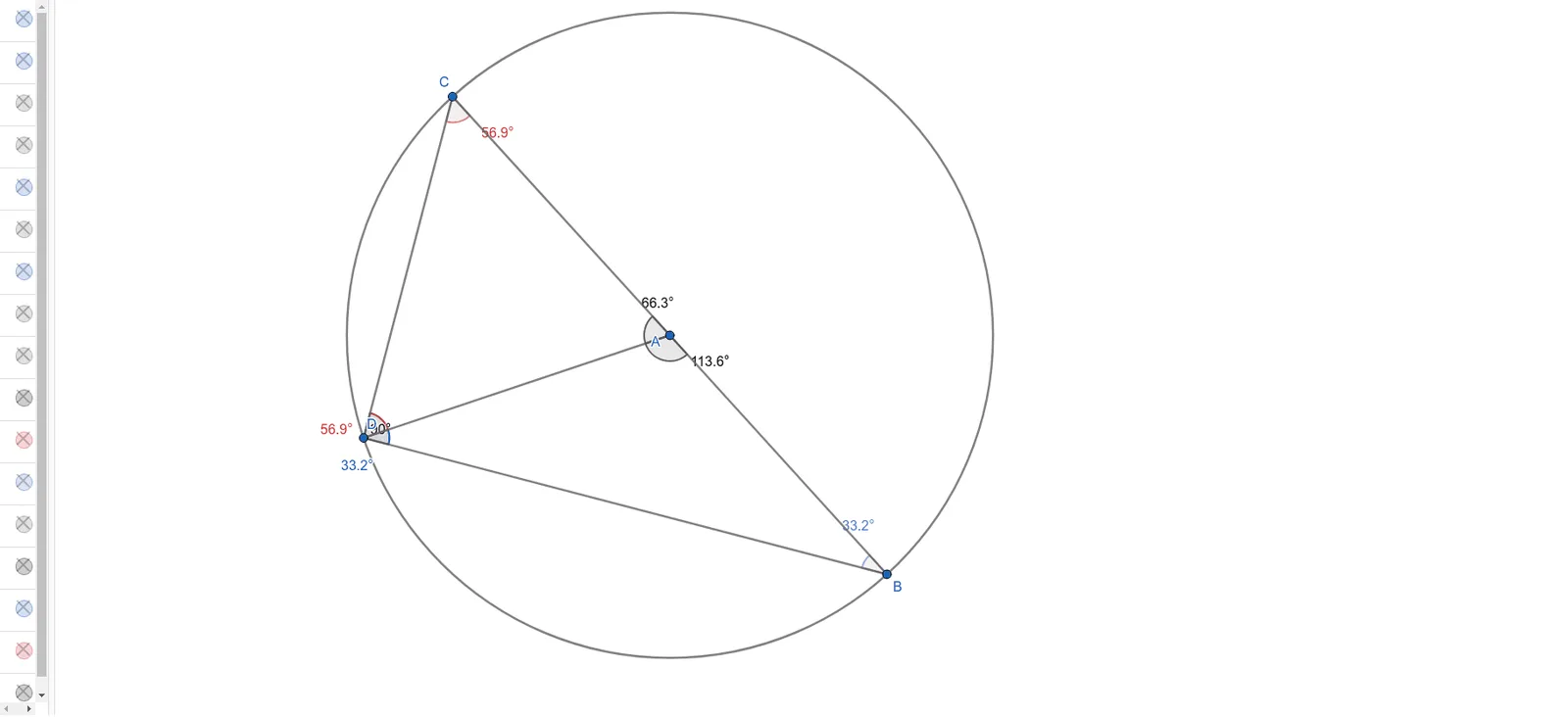
This example demonstrates the proof of the circle theorem using isosceles triangles. It shows the relationship between the inscribed angle and the central angle. GeoGebra commands used include Circle, Segment, Point, and Angle. Suitable for junior high school geometry, aiding students in understanding the theorem and its proof.
GeoGebra Commands & Parameters
Circle(A, B) → cSegment(B, A) → fPoint(c) → CSegment(A, C) → gPoint(c) → DSegment(C, D) → hSegment(D, B) → iAngle(C, D, B) → αAngle(A, C, D) → βAngle(A, B, D) → γSegment(A, D) → jAngle(B, A, D) → δAngle(B, D, A) → εAngle(A, D, C) → ζAngle(C, A, D) → η
AI Drawing Prompt Reference
Draw a circle and select two points on it to form a line segment. From one endpoint, draw a line segment to the center of the circle, and from another point on the circle, draw a line segment to the same endpoint, creating two intersecting segments. Label the angles formed by the intersecting segments and show the angles formed by each segment with the center of the circle. Demonstrate the relationship between the inscribed angle and the central angle to illustrate the proof of the circle theorem.
The prompt above was compiled from the original drawing commands and is for reference only.