
Practice: Inscribed Angles and Chords in a Circle
Loading the math board and drawing, please wait…
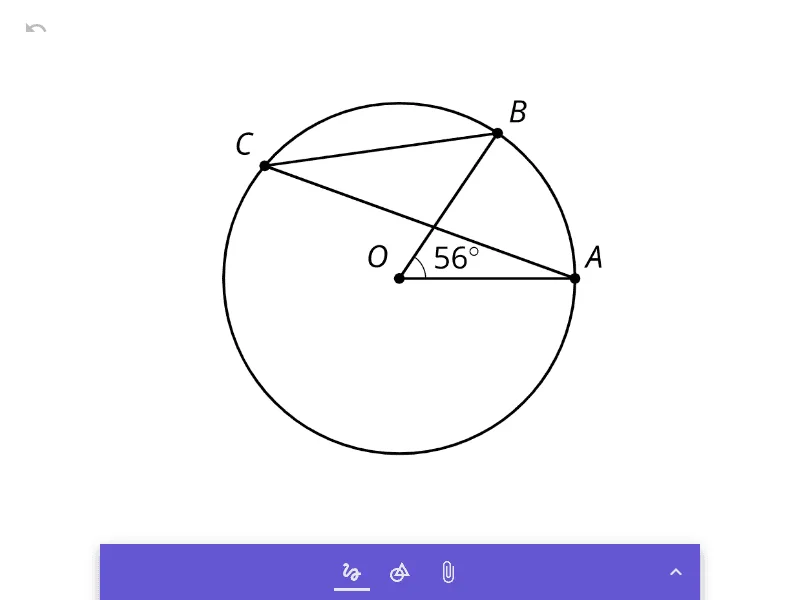
This example demonstrates the geometric relationships between inscribed (circumference) angles and the chords they intercept in a circle. It focuses on core ideas such as circles and chords, inscribed/circumference angles, and the Inscribed Angle Theorem—especially the fact that angles subtending the same chord are equal (independent of where the vertex lies on the circle). Construction typically involves creating a circle, placing points on the circumference, drawing chords/line segments to form the intercepted chord, and measuring or labeling the angle formed by the two chord lines to verify the theorem under different configurations. Suitable for middle-school geometry practice, classroom demonstrations, and interactive learning of fundamental circle-angle properties.
AI Drawing Prompt Reference
Draw a circle with three points on its circumference. Two points serve as endpoints of a chord, and the third point lies elsewhere on the circle. Connect these points with line segments to form a triangle, where the chord is one side. Mark the inscribed angle subtended by the chord, formed by the chord's endpoints and the third point. Then place another point on the circle, connect it to the chord's endpoints to create a second inscribed angle. Highlight both angles with distinct colors or labels, showing they are equal, to demonstrate that angles subtending the same chord are equal.
The prompt above was compiled from the original drawing commands and is for reference only.