
Practice: Conditions for Triangle Similarity via Midlines and Angles
Loading the math board and drawing, please wait…
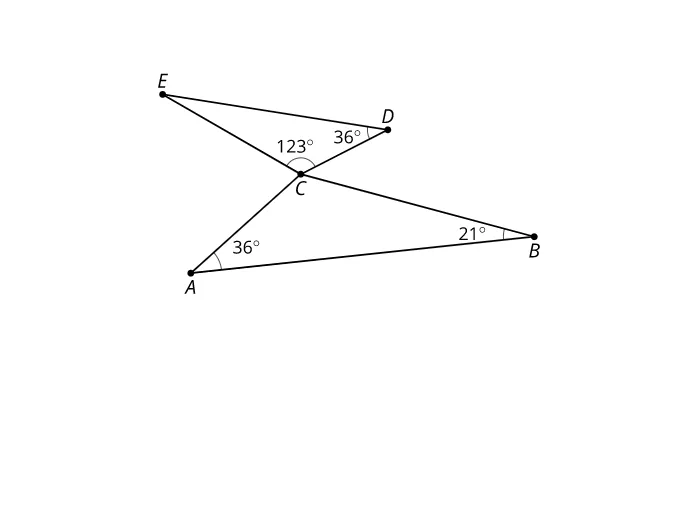
This GeoGebra example demonstrates how to decide whether two triangles are similar by checking specific, visually verifiable conditions. It highlights the geometry phenomenon that similarity can be detected through angle correspondence and structural features such as triangle midlines. Key concepts include triangle similarity criteria (e.g., two corresponding angles equal), the midline theorem (joining midpoints creates a line parallel to the third side), coordinate-geometry construction of points (vertices and midpoints), and transformations such as translation to align figures for comparison. Using the construction summary (object pic1), the diagram is built by placing triangle vertices on the coordinate plane, constructing midpoints, forming midlines from midpoint connections, and then using angle measurements/parallel relationships to confirm the similarity conditions. Suitable for middle and high school learners and for lesson demonstrations, practice, and exploratory learning in similarity and coordinate geometry.
AI Drawing Prompt Reference
Draw two triangles on a coordinate plane, with one triangle's vertices placed at specific coordinates and the other translated for comparison. First, plot the three vertices of the first triangle and connect them to form the triangle. Then, find the midpoints of two sides and connect these midpoints to create a midline, which should be parallel to the third side. Next, draw a second triangle elsewhere, ensuring one of its angles matches a corresponding angle of the first triangle and its corresponding sides are parallel or proportional. Finally, mark equal angles and parallel lines with angle symbols or parallel marks to visually demonstrate the similarity conditions.
The prompt above was compiled from the original drawing commands and is for reference only.