
Powers of Powers
Loading the math board and drawing, please wait…
In collections
Rechnen mit Potenzen
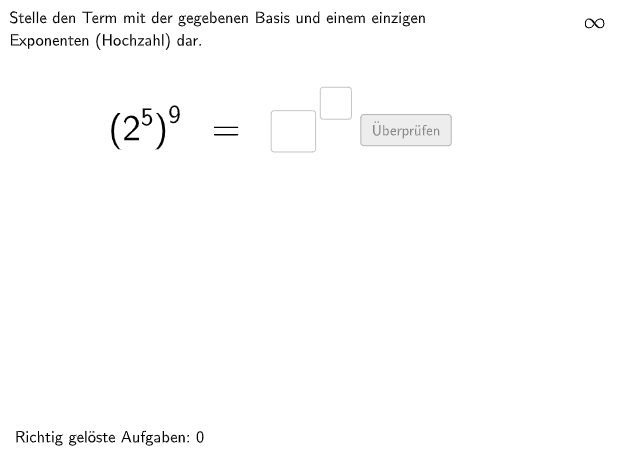
This example demonstrates the rule of powers of powers, involving the core mathematical concept of power operations. Using GeoGebra commands such as Textfield and Shuffle, students can understand and apply the rule of powers of powers. Suitable for 7-8 grade students for practice.
GeoGebra Commands & Parameters
Textfield(input1) → InputBox1Textfield(input2) → InputBox2Shuffle({1, 2}) → ModusList, {2, 1}Shuffle(Sequence[i, i, 2, 9]) → AStartList, {5, 6, 3, 4, 7, 8, 9, 2}Shuffle(Sequence[i, i, 2, 9]) → AMidList, {5, 7, 2, 9, 4, 6, 8, 3}If(questionCount < 4, questionCount, 4) → metaprogressionShuffle(Sequence[i, i, 2, 9]) → BStartList, {9, 2, 3, 6, 8, 5, 4, 7}Shuffle(Sequence[i, i, 2, 9]) → BMidList, {3, 2, 7, 5, 8, 9, 6, 4}Shuffle(Sequence[i, i, 2, 10]) → XStartList, {2, 10, 7, 9, 6, 8, 3, 5, 4}Shuffle(Sequence[i, i, -9, 18] \ {0}) → XGanzzhahlList, {12, -2, -4, 8, 1, -3, -7, 11, 7, 18, 5, 4, 15, -6, 10, 3, 17, 16, -9, 2, 6, -8, -5, 13, 9, 14, -1}Shuffle(Sequence[i, i, 20, 50]) → XDezizahlListHelper, {21, 39, 34, 29, 33, 40, 43, 38, 23, 30, 26, 49, 24, 32, 31, 28, 45, 36, 37, 42, 47, 25, 41, 48, 20, 50, 46, 44, 22, 35, 27}Shuffle(Join[{XDezizahlList, XGanzzhahlList}]) → XMidList, {11, 2, 12, 18, 4.3, 3.2, 7, 5, 8, 17, 13, 4.6, -5, 2.7, 3.6, -9, 3.1, 3.7, 3.4, 4.1, 2.5, 4, 4.5, 6, 3.3, 2.2, 1, 2.6, 3.5, 4, 4.4, 3.9, 2.1, 3, -4, -3, 2.3, 9, 10, 2, -2, 3, 16, -6, 4.9, 4.8, -1, 15, 5, 2.4, 3.8, 2.9, 2.8, 14, 4.2, 4.7, -7, -8}Polygon(PtopLeftCornerFeedback, PtopRightCornerFeedback, PbottomRightCornerFeedback, PbottomLeftCornerFeedback) → rectangleCorrect, rectangleCorrectS3, rectangleCorrectS4, rectangleCorrectS2, rectangleCorrectS1Shuffle(Sequence[Random[0, 10], i, 1, 100]) → randomNosForX, {4, 5, 8, 10, 6, 9, 6, 9, 1, 2, 0, 5, 7, 9, 0, 5, 6, 0, 10, 3, 4, 6, 0, 1, 4, 4, 1, 1, 5, 0, 5, 5, 7, 6, 10, 9, 1, 3, 2, 6, 0, 6, 2, 5, 1, 1, 3, 6, 8, 5, 0, 7, 3, 10, 2, 1, 5, 8, 6, 2, 0, 9, 1, 6, 6, 4, 9, 1, 7, 8, 4, 0, 5, 3, 5, 8, 8, 3, 5, 3, 5, 1, 1, 3, 10, 0, 3, 1, 4, 6, 8, 1, 9, 1, 1, 3, 7, 0, 9, 3}Element(randomNosForX, Mod[questionCount, 100] + 1) → numXShuffle(Sequence[Random[0, 10], i, 1, 100]) → randomNosForY, {9, 7, 1, 0, 8, 7, 0, 0, 3, 7, 4, 2, 3, 8, 10, 2, 2, 1, 10, 8, 6, 0, 4, 4, 3, 3, 7, 6, 2, 0, 7, 0, 10, 1, 6, 0, 1, 4, 7, 9, 10, 1, 8, 3, 10, 7, 7, 5, 9, 1, 0, 8, 1, 8, 5, 0, 8, 0, 7, 7, 2, 4, 7, 5, 0, 6, 2, 6, 1, 7, 0, 10, 7, 2, 0, 3, 6, 7, 1, 6, 3, 9, 1, 3, 2, 8, 8, 7, 10, 7, 0, 5, 1, 10, 0, 4, 7, 9, 7, 4}Element(randomNosForY, Mod[questionCount, 100] + 1) → numYAppend(true, Sequence[If[randomNosForX(i) ≟ randomNosForX(i - 1), false, true], i, 2, 100]) → stayXAppend(true, Sequence[If[randomNosForY(i) ≟ randomNosForY(i - 1), false, true], i, 2, 100]) → stayYRemove(Sequence[If[stayX(i), randomNosForX(i), 0], i, 1, 100], Sequence[0, i, 1, 100]) → randomNosForXwithoutRepeatRemove(Sequence[If[stayY(i), randomNosForY(i), 0], i, 1, 100], Sequence[0, i, 1, 100]) → randomNosForYwithoutRepeatElement(randomNosForXwithoutRepeat, Mod[questionCount, Length[randomNosForXwithoutRepeat]] + 1) → numXwithoutRepeatElement(randomNosForYwithoutRepeat, Mod[questionCount, Length[randomNosForYwithoutRepeat]] + 1) → numYwithoutRepeatText(Text2, E, false, true, -1, 0) → Text6Text(Text3, F, false, true, -1, 0) → Text7
AI Drawing Prompt Reference
Create a clear instructional diagram for practicing the power-of-powers rule: include two input boxes where the user can enter the problem parameters. Construct a rectangle by defining four corner points and connecting them in order to form its boundary. Use the rectangle as the main display area for the exercise. Add two separate text fields/labels to present the contents corresponding to parameters E and F, positioned so they match the rectangle area. Keep the layout simple and readable, with the rectangle as the central element.
The prompt above was compiled from the original drawing commands and is for reference only.