
Ordering Rational Numbers by csegarra
Loading the math board and drawing, please wait…
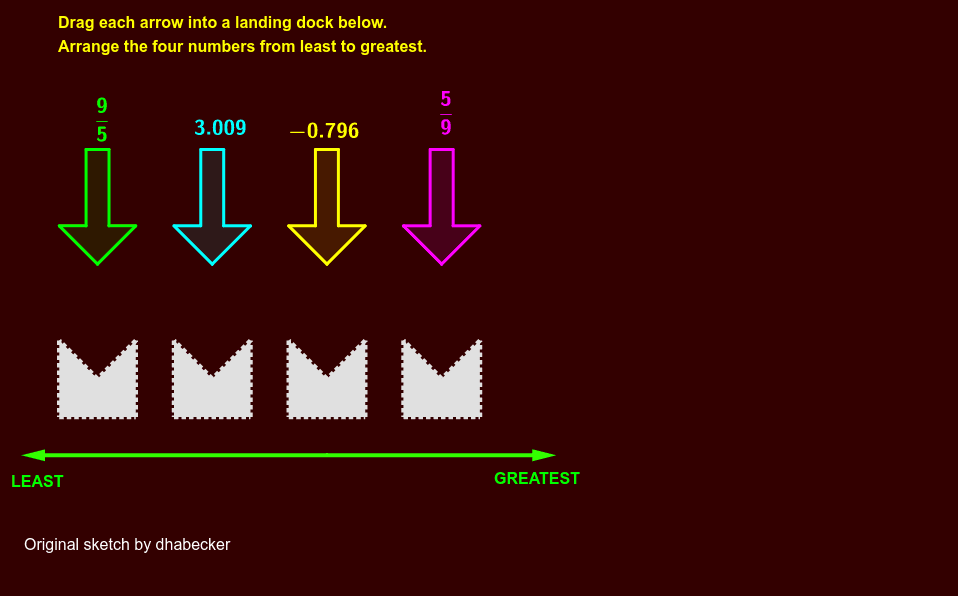
This example demonstrates the process of ordering four rational numbers on a number line. It involves core math concepts like rational numbers, number line, and inequalities. Constructed using GeoGebra commands such as Line, Point, Segment, and If. Suitable for middle school mathematics teaching to help students understand rational number comparison and number line representation.
GeoGebra Commands & Parameters
OrthogonalLine(A, xAxis) → bLine(C_2, B_2) → cIntersect(b, c) → D_2Vector((x(A), y(A)), (x(A) + a, y(A) + a)) → uLine(J, xAxis) → fOrthogonalLine(B, f) → gIntersect(f, g) → KMirror(L, g) → L'Mirror(J, g) → J'Mirror(M, g) → FLine(O, xAxis) → hOrthogonalLine(C, h) → iIntersect(h, i) → PMirror(Q, i) → Q'Mirror(O, i) → O'Mirror(R, i) → GPolygon(A, B_2, E_2, E, G_2, F_2, C_2) → poly1, a_1, b_1, e_1, h_1, g_1, f_1, c_1Polygon(C, O', Q', G, R, Q, O) → poly2, n, o', q', r', r, q, oPolygon(B, J', L', F, M, L, J) → poly3, i_1, j', l', m', m, l, jLine(T, xAxis) → kOrthogonalLine(D, k) → pIntersect(k, p) → UMirror(V, p) → V'Mirror(T, p) → T'Mirror(W, p) → HPolygon(D, T', V', H, W, V, T) → poly4, s, t', v', w', w, v, tLine(A_1, xAxis) → d_1OrthogonalLine(Z, d_1) → j_1Intersect(d_1, j_1) → C_1Mirror(A_1, j_1) → D_1Mirror(B_1, j_1) → E_1Vector((0, 0), (z, 0)) → u_1Translate(A_1, u_1) → F_1Translate(B_1, u_1) → G_1Translate(Z, u_1) → Z'Translate(E_1, u_1) → H_1Translate(D_1, u_1) → I_1Translate(F_1, u_1) → J_1Translate(G_1, u_1) → K_1Translate(Z', u_1) → Z''Translate(H_1, u_1) → L_1Translate(I_1, u_1) → M_1Translate(J_1, u_1) → N_1Translate(K_1, u_1) → O_1Translate(Z'', u_1) → Z'''Translate(L_1, u_1) → P_1Translate(M_1, u_1) → Q_1Polygon(Z, A_1, B_1, E_1, D_1) → poly5, z_1, a_2, b_2, e_2, d_2Polygon(Z', F_1, G_1, H_1, I_1) → poly6, z', f_2, g_2, h_2, i_2Polygon(Z'', J_1, K_1, L_1, M_1) → poly7, z'', j_2, k_1, l_1, m_1Polygon(Z''', N_1, O_1, P_1, Q_1) → poly8, z''', n_1, o_1, p_1, q_1Segment(R_1, S_1) → r_1Point(r_1) → T_1Vector(T_1, S_1) → v_1Vector(T_1, R_1) → w_1If(decimal > fracadjusted, 1, 0) → Ascore_1If(decimal > decimaltwo, 1, 0) → Ascore_2If(decimal > percentadjusted, 1, 0) → Ascore_3If(fracadjusted > decimal, 1, 0) → Bscore_1If(fracadjusted > decimaltwo, 1, 0) → Bscore_2If(fracadjusted > percentadjusted, 1, 0) → Bscore_3If(decimaltwo > decimal, 1, 0) → Cscore_1If(decimaltwo > fracadjusted, 1, 0) → Cscore_2If(decimaltwo > percentadjusted, 1, 0) → Cscore_3Vector(I, N) → s_1Vector(I, S) → t_1
AI Drawing Prompt Reference
Draw a horizontal line as a number axis in a coordinate system, marking the origin and unit length. From the origin, draw four points to the right representing rational numbers, connecting adjacent points with line segments to form a polyline on the number axis. Label each point with its corresponding rational number and use inequality signs to connect adjacent numbers, showing their relative sizes.
The prompt above was compiled from the original drawing commands and is for reference only.