
Net of Pyramid
Loading the math board and drawing, please wait…
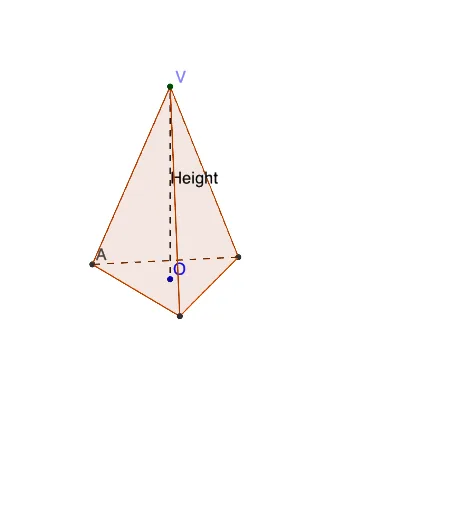
This example demonstrates the net of a pyramid and its fundamental properties. It involves core mathematical concepts such as polygons, triangles, vectors, coordinate geometry, and solid geometry. The construction utilizes GeoGebra commands and objects like Sequence, Polygon, Line, Point, Segment, Vector, LineBisector, Intersect, UnitVector, and Circle as outlined in the construction summary. It is suitable for high school students learning solid geometry and geometric constructions.
GeoGebra Commands & Parameters
Sequence(Rotate[A, ((360 * ° / n) * k), O], k, 0, n - 1, 1) → VerticesPolygon(Vertices) → PolygonLine(O, zAxis) → aPoint(a) → VSegment(O, V) → HeightSegment(A, V) → SlantEdgeVector((0, 0, 1)) → ZLineBisector(Element[Vertices, 1], Element[Vertices, 2]) → ReferencePerpendicularBisectorIntersect(ReferencePerpendicularBisector, Line[Element[Vertices, 1], Element[Vertices, 2]]) → ReferenceIntersectionPointVector(O, ReferenceIntersectionPoint) → ReferenceVectorUnitVector(ReferenceVector) → ReferenceUnitVectorSequence(Vector[Rotate[ReferenceUnitVector, ((360 * ° / n) * k), O]], k, 0, n - 1, 1) → ReferenceAllUnitVectorCircle(Element[Vertices, 1], SlantEdge) → cCircle(Element[Vertices, 2], SlantEdge) → dIntersect(c, d) → B, C, ,Segment(O, C) → FlattenLengthSequence(O + ((FlattenLength * cos(angle)) * Element[ReferenceAllUnitVector, k]) + ((Height * sin(angle)) * Z), k, 1, n, 1) → AllVerticesPolygon(Element[Vertices, 1], Element[AllVertices, 1], Element[Vertices, 2]) → poly1, b, e, fPolygon(Element[Vertices, 2], Element[AllVertices, 2], Element[Vertices, 3]) → poly2, g, h, iSequence(Polygon[Element[Vertices, k], Element[AllVertices, k], Element[Vertices, k + 1]], k, 1, n - 1, 1) → AllTrianglesPolygon(Element[Vertices, n], Element[AllVertices, n], Element[Vertices, 1]) → FinalTriangle, j, k, l
AI Drawing Prompt Reference
Draw the net of a pyramid, including the base polygon and triangular faces. Start by drawing the base polygon, then draw a height line from the apex to the center of the base. Next, draw circles centered at the base center with radii equal to the slant edges, intersecting at points that become the vertices of the triangular faces. Finally, connect these triangular faces to the base polygon to form the complete net.
The prompt above was compiled from the original drawing commands and is for reference only.