
MPM1DA L20 Rectangle Yes or No
Loading the math board and drawing, please wait…
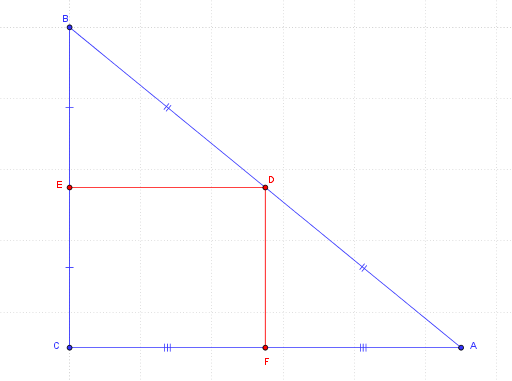
① This GeoGebra example dynamically demonstrates how to determine whether a given quadrilateral is a rectangle, providing a clear 'Yes' or 'No' conclusion. ② Core mathematical concepts include the definition and criteria for rectangles, the Pythagorean theorem (to verify right angles), properties of straight lines and segments, and geometric construction techniques. ③ Construction details: using GeoGebra's 'Segment' command to create sides and 'Midpoint' command to construct diagonal intersections or auxiliary points, involving points A, B, C, D, E, F and segments a, b, c, d, e, f, g, h, i, j, k; measurements of side lengths or angles are used to test rectangle properties. ④ Suitable for the MPM1DA course (Grade 9 applied mathematics) in Ontario, Canada, or middle school geometry, ideal for classroom demonstrations, student exploration of rectangle criteria, and as interactive material for assignments or quizzes.
GeoGebra Commands & Parameters
Segment(A, B) → aSegment(B, C) → bSegment(C, A) → cMidpoint(b) → EMidpoint(a) → DMidpoint(c) → FSegment(E, D) → dSegment(F, D) → eSegment(D, A) → fSegment(B, D) → gSegment(B, E) → hSegment(E, C) → iSegment(C, F) → jSegment(F, A) → k
AI Drawing Prompt Reference
Draw a triangle with three vertices. Mark the midpoint of each side. Connect these midpoints to form an inner triangle. Then draw segments from each vertex to the midpoint of the opposite side, creating three medians. Additionally, connect each midpoint to the adjacent vertices and to other midpoints, forming a network of segments inside the triangle. The final figure shows a triangle filled with intersecting lines and smaller triangles, useful for exploring midpoint properties and segment relationships.
The prompt above was compiled from the original drawing commands and is for reference only.