
Matrix Multiplications for Transformations with Homogeneous Coordinates
Loading the math board and drawing, please wait…
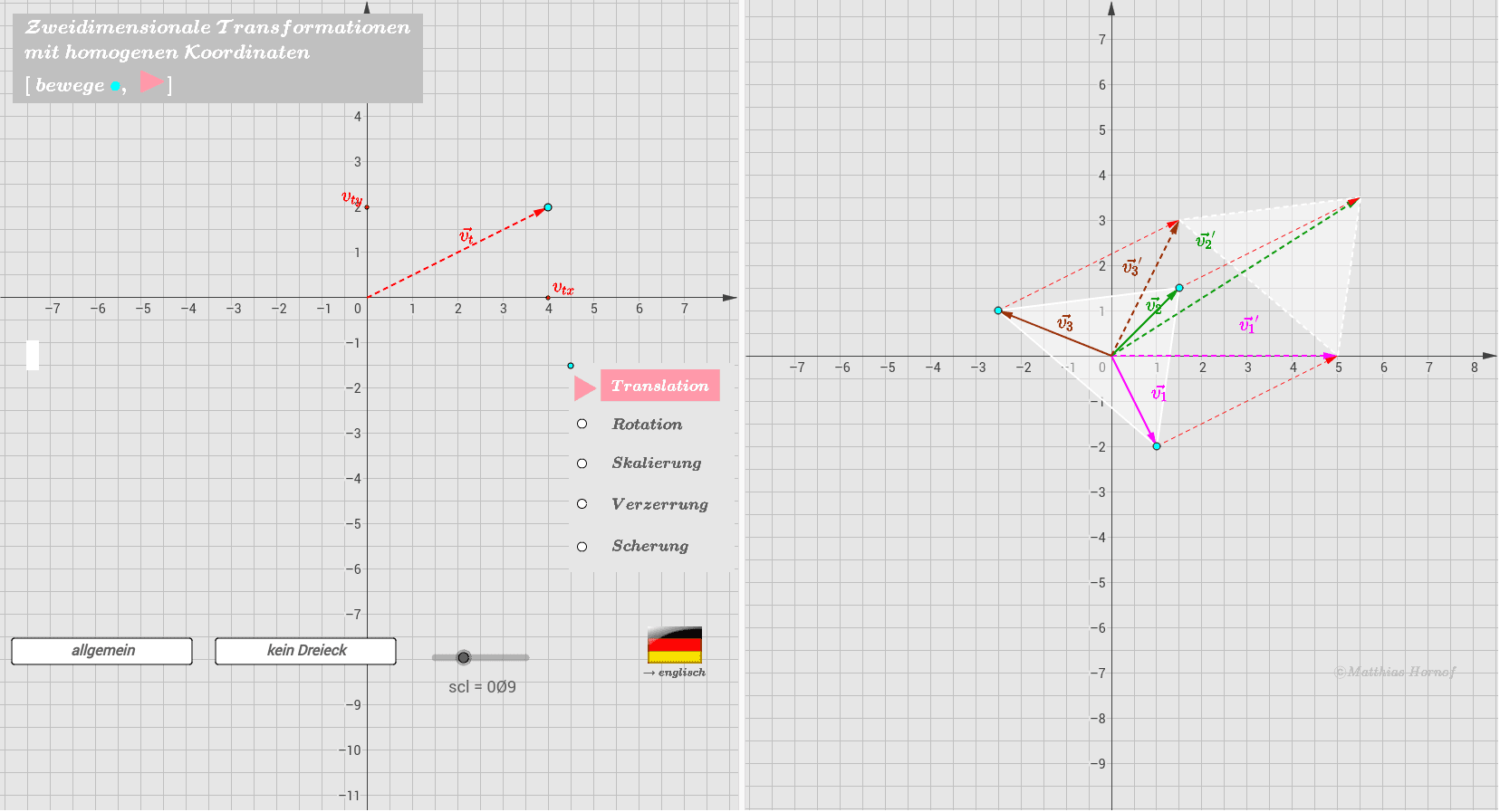
This example demonstrates how to use homogeneous coordinates for geometric transformations via matrix multiplications. Key concepts include homogeneous coordinates, matrix multiplication, and geometric transformations. It utilizes commands like Segment, Point, Circle, Angle, Vector, Polygon, etc. Suitable for high school mathematics education and learning.
GeoGebra Commands & Parameters
Segment(Pos + (0.25, -0.5), Pos + (0.25, -4)) → psPoint(ps) → NvCircle(M_0, M_1) → dPoint(d) → M_2Angle(M_1, M_0, M_2) → dwPoint(xAxis) → S_xPoint(yAxis) → S_yVector((0, 0), P_1) → v_1Vector((0, 0), T) → v_TVector((0, 0), P_2) → v_2Vector((0, 0), P_3) → v_3Vector(P_1, P_1 + v_T) → v_{t1}Vector(P_2, P_2 + v_T) → v_{t2}Vector(P_3, P_3 + v_T) → v_{t3}Polygon(Q_1, Q_2, Q_3) → Vieleck2, a, b, cPolygon(P_1, P_2, P_3) → Vieleck1, p_3, p_1, p_2CircleArc(M_0, M_1, M_2) → eIf(tr ≟ 0, "1", If[w0, "\textcolor{red}{" + (Text[cos(dw)]) + "}", "\textcolor{red}{cos(\alpha)}"]) → A_{11}If(tr ≟ 0, "0", If[w0, "\textcolor{red}{" + (Text[(-sin(dw))]) + "}", "\textcolor{red}{-sin(\alpha)}"]) → A_{12}If(tr ≟ 0, If[w0, "\textcolor{red}{" + (Text[x(T)]) + "}", "\textcolor{red}{v_{tx}}"], "0") → A_{13}If(tr ≟ 0, "0", If[w0, "\textcolor{red}{" + (Text[sin(dw)]) + "}", "\textcolor{red}{sin(\alpha)}"]) → A_{21}If(tr ≟ 0, "1", If[w0, "\textcolor{red}{" + (Text[cos(dw) + "}"]), "\textcolor{red}{cos(\alpha)}"]) → A_{22}If(tr ≟ 0, If[w0, "\textcolor{red}{" + (Text[y(T)]) + "}", "\textcolor{red}{v_{ty}}"], "0") → A_{23}CircleArc((0, 0), P_1, (0, 0) + w_1) → k_1CircleArc((0, 0), P_2, (0, 0) + w_2) → k_2CircleArc((0, 0), P_3, (0, 0) + w_3) → k_3Vector((0, 0), S_x) → u_{sx}Vector((0, 0), S_y) → u_{sy}Vector((0, 0), Sch) → u_{sch}Sequence(Pos + (Element[Pos_2, i, 1], Element[Pos_2, i, 2]), i, 1, 5) → Lnv