
Length Unit Conversion Practice
Loading the math board and drawing, please wait…
In collections
Wiederholung: Längen- und Flächenmaße
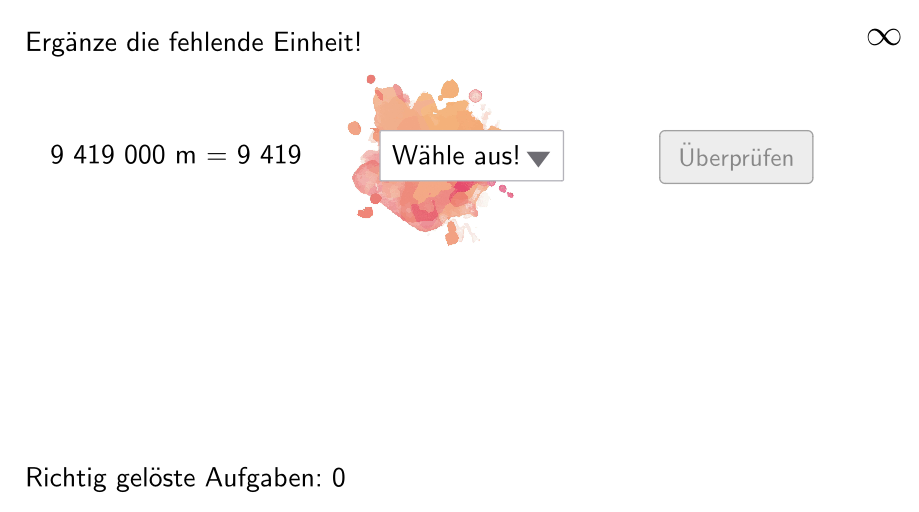
This example demonstrates length unit conversion exercises, involving the core mathematical concept of converting between different length units. Using GeoGebra commands such as Join, Element, If, etc., the process of unit conversion is dynamically displayed. Suitable for students in grades 5-6.
GeoGebra Commands & Parameters
Join(Sequence[Shuffle[{1, 2, 3, 4, 5, 6}], i, 1, 20]) → ListeBeispielCountElement(ListeBeispielCount, Mod[questionCount, 100]) → BeispielCountJoin(Sequence[Shuffle[{true, false}], i, 1, 50]) → ListeWWGroßAufKleinElement(ListeWWGroßAufKlein, Mod[questionCount, 100]) → großAufKleinIf(allowDecimalNumbers, Element[If[großAufKlein, ListeKommaGroßAufKlein, ListeKommaKleinAufGroß], BeispielCount], Element[If[großAufKlein, ListeGroßAufKlein, ListeKleinAufGroß], BeispielCount]) → BeispielElement(Beispiel, 2) → einheit2Join({{"$\textsf{Wähle aus!\vphantom{Öj}}$"}, {"$\textsf{mm\vphantom{Öj}}$", "$\textsf{\vphantom{Öj}cm}$", "$\textsf{dm\vphantom{Öj}}$", "$\textsf{m\vphantom{Öj}}$", "$\textsf{km\vphantom{Öj}}$"}}) → LLIndexOf(SelectedElement[LL], LL) → EinheitGewähltShuffle(Sequence[Random[111, 9999], i, 1, 100]) → randomNosForX, {142, 9419, 7477, 3020, 9077, 5480, 9957, 3907, 346, 4916, 5051, 5321, 4151, 6127, 2480, 7598, 3164, 7991, 1072, 5681, 6729, 1819, 216, 1819, 7731, 5808, 6375, 7836, 993, 6859, 2914, 5645, 5556, 4642, 2529, 8736, 8654, 8119, 9377, 506, 5669, 5728, 140, 7282, 690, 7938, 4609, 9781, 2527, 6358, 2716, 2224, 9642, 9733, 1810, 6219, 7174, 4744, 4722, 5900, 8984, 322, 7907, 2590, 7553, 1253, 823, 8917, 7656, 3447, 3426, 7723, 7567, 1441, 4689, 5477, 1030, 133, 8217, 592, 3989, 7207, 2078, 2876, 7812, 7721, 7981, 8713, 1457, 6200, 4989, 2512, 1329, 7367, 9579, 2960, 2549, 7795, 4815, 9412}Append(true, Sequence[If[randomNosForX(i) ≟ randomNosForX(i - 1), false, true], i, 2, 100]) → stayXRemove(Sequence[If[stayX(i), randomNosForX(i), 0], i, 1, 100], Sequence[0, i, 1, 100]) → randomNosForXwithoutRepeatElement(randomNosForXwithoutRepeat, Mod[questionCount, Length[randomNosForXwithoutRepeat]] + 1) → numXwithoutRepeatElement(Beispiel, 1) → einheit1If(großAufKlein, Element[Beispiel, 4], 1 / Element[Beispiel, 4]) → faktorCorrectShuffle(Sequence[Random[1, 3], i, 1, 100]) → ListeFaktoren, {3, 3, 1, 3, 3, 3, 2, 1, 1, 1, 1, 1, 1, 2, 3, 1, 3, 3, 3, 1, 3, 1, 2, 2, 1, 2, 3, 2, 3, 1, 2, 2, 1, 2, 1, 2, 1, 2, 3, 1, 1, 3, 3, 2, 3, 1, 3, 2, 2, 1, 2, 3, 2, 3, 1, 3, 2, 2, 3, 2, 2, 2, 1, 1, 3, 3, 1, 3, 2, 2, 2, 1, 2, 1, 3, 3, 1, 2, 1, 2, 3, 1, 1, 2, 2, 2, 3, 2, 2, 2, 3, 2, 2, 1, 3, 1, 1, 1, 1, 2}Element(ListeFaktoren, Mod[questionCount, 100]) → positionFaktor0Element(Element[Beispiel, 3], positionFaktor0) → faktor0NumberSeperation(num) → NumSeperatedNumberSeperation(numCorrect) → TextNumCorrectTextfield(aInput) → InputBox1Textfield(bInput) → InputBox2Polygon(PtopLeftCornerFeedback, PtopRightCornerFeedback, PbottomRightCornerFeedback, PbottomLeftCornerFeedback) → rectangleCorrect, ptopleftcornerfeedback, ptoprightcornerfeedback, pbottomrightcornerfeedback, pbottomleftcornerfeedbackElement(randomNosForX, Mod[questionCount, 100] + 1) → numX
AI Drawing Prompt Reference
Create a learning graphic for a “length unit conversion practice.” Include a selection area that says “Wähle aus!” and shows a row of units: mm, cm, dm, m, km, indicating the student chooses a target unit (unit 1). Generate a numeric value to convert and present it as part of the question, with a second unit (unit 2) implied to define the conversion direction. Arrange everything inside a rectangular panel formed by four corner points, and within the rectangle include an input area for the student’s answer plus a small feedback text area associated with the conversion.
The prompt above was compiled from the original drawing commands and is for reference only.