
Law of Cosines Demonstration by John Golden
Loading the math board and drawing, please wait…
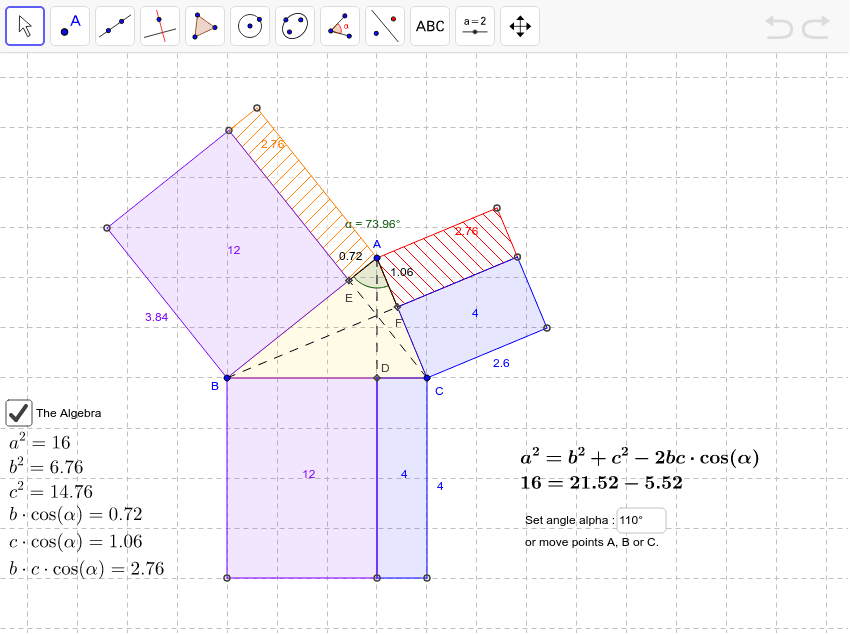
This example demonstrates the Law of Cosines in an arbitrary triangle, showing the relationship between side lengths and angles dynamically. It involves core mathematical concepts such as the Law of Cosines and its connection to the Pythagorean Theorem. The construction uses GeoGebra commands and objects like Polygon, Line, OrthogonalLine, Intersect, Segment, Angle, Ray, Rotate, Circle, Textfield, and Midpoint. It is suitable for high school mathematics education, helping students visually understand the proof and application of the Law of Cosines.
GeoGebra Commands & Parameters
Polygon(A, B, C) → poly1, c, a, bLine(B, A) → dLine(C, A) → eOrthogonalLine(C, d) → fOrthogonalLine(B, e) → gOrthogonalLine(A, a) → hIntersect(h, a) → DIntersect(d, f) → EIntersect(e, g) → FPolygon(C, B, 4) → poly2, i, j, k, l, G, HPolygon(A, C, 4) → poly3, m, n, p, q, I, JPolygon(B, A, 4) → poly4, r, s, t, a_1, K, LLine(L, K) → b_1Line(I, J) → c_1Intersect(f, b_1) → MIntersect(g, c_1) → NPolygon(A, E, M, K) → poly5, a_2, e_1, m_1, k_1Polygon(A, F, N, J) → poly6, a_3, f_1, n_1, j_1Intersect(h, k) → OPolygon(D, C, H, O) → poly7, d_1, c_2, h_1, oPolygon(D, O, G, B) → poly8, d_2, o_1, g_1, b_2Polygon(B, E, M, L) → poly9, b_3, e_2, m_2, l_1Polygon(C, I, N, F) → poly10, c_3, i_1, n_2, f_2Segment(A, D) → p_1Segment(C, E) → q_1Segment(B, F) → r_1Angle(B, A, C) → αSegment(A, E) → s_1Segment(A, F) → t_1Ray(B, C) → g_2Ray(C, B) → h_2Rotate(C, (-((180° - setalpha) / 2)), C) → C'Rotate(B, (-((180° - (2 * setalpha)) / 2)), C) → B'Ray(C', B') → i_2Rotate(B, (180° - (2 * setalpha)) / 2, B) → B'_1Rotate(C, (180° - (2 * setalpha)) / 2, B) → C'_1Ray(B'_1, C'_1) → j_2Intersect(i_2, j_2) → PCircle(P, C) → k_2Ray(D, A) → l_2Intersect(k_2, l_2) → Q,Textfield(setalpha) → inputBox1Midpoint(B, C) → RCircle(R, C) → p_2Intersect(p_2, l_2) → S,
AI Drawing Prompt Reference
Draw a geometric figure demonstrating the Law of Cosines. The figure should include an arbitrary triangle, and elements that show the relationship between side lengths and angles. Key objects include triangles, line segments, angles, rays, circles, and a text box. The construction order should start with drawing the triangle, then adding related line segments and angles, and finally using rotations and circle constructions to show the theorem's relationship.
The prompt above was compiled from the original drawing commands and is for reference only.