
Kite Rhomboidicity Demonstration
Loading the math board and drawing, please wait…
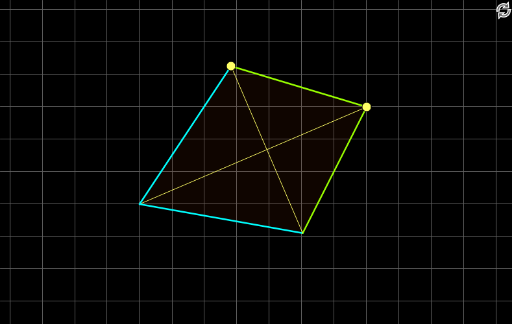
This example demonstrates how to calculate the rhomboidicity of a kite using coordinate geometry methods. The core math concepts involved include coordinate geometry, quadratic functions, coordinate calculations, exponential functions, and polygonal geometric properties. Construction highlights involve using commands and objects in GeoGebra such as Segment, OrthogonalLine, Mirror, Polygon, Intersect, and Angle. Suitable for high school students learning about polygon properties and applications of coordinate geometry.
GeoGebra Commands & Parameters
Segment(A, B) → aOrthogonalLine(C, a) → bMirror(C, a) → C'Polygon(A, C, B, C') → poly1, a_1, c, b_1, c'Segment(C, C') → dIntersect(d, a) → DAngle(A, D, C) → αSegment(C, D) → fSegment(D, C') → g
AI Drawing Prompt Reference
Draw a kite-shaped rhombus to demonstrate its rhomboidicity using coordinate geometry. Start by drawing a side, then draw a perpendicular line from a point to this side, reflect the point across the perpendicular line, and connect these points to form a rhombus. Next, draw a perpendicular line from the reflected point to the original side, connect the intersection point with the vertices, and measure the angle formed by one vertex, the intersection, and the reflected point to show geometric properties.
The prompt above was compiled from the original drawing commands and is for reference only.