
Kite Array: Symmetric Geometric Art with Natural Numbers and Piecewise Functions
Loading the math board and drawing, please wait…
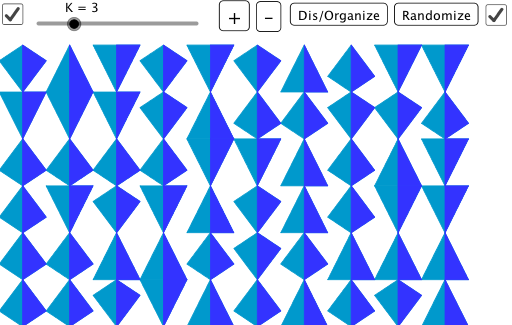
① This example demonstrates a geometric array composed of multiple kite-shaped units arranged with symmetry, forming a rhythmic artistic pattern inspired by the work of artist David Mrugala. ② Core mathematical concepts include symmetry, straight lines, natural number sequences, piecewise functions, and indefinite integrals (used to define boundaries or filled regions), along with algebra and matrix operations. ③ Construction highlights: The GeoGebra Sequence command generates sequence objects (such as K, f1, b, N, M), while matrices (matrix1) and lists (list1, list2, list3) control point positions and transformations. Multiple buttons (button1~button4) allow interactive parameter adjustments, and sliders (a, r) along with piecewise functions define the kite shape boundaries, resulting in a dynamic, adjustable array. ④ Suitable for high school to university-level teaching that integrates mathematics and art, useful for explaining symmetry transformations, sequence generation, piecewise function definitions, and visualization of indefinite integrals, as well as inspiring creative coding and mathematical modeling.
GeoGebra Commands & Parameters
Sequence(Sequence[If[b, f1(i, j), Random[0, K]], i, 1, N], j, 1, M) → matrix1Sequence(Sequence[Corner[1] + (i, j), i, 0, N], j, 0, M) → list1Sequence(Sequence[kite[Element[Element[list1, j], i], Element[Element[list1, j], i] + (1, 1), Element[matrix1, j, i] / K], i, 1, N], j, 1, M) → list2Sequence(Sequence[shade[Element[Element[list1, j], i], Element[Element[list1, j], i] + (1, 1), Element[matrix1, j, i] / K], i, 1, N], j, 1, M) → list3