
Isosceles Triangles and Parallelograms on a Triangle by Doug Kuhlmann
Loading the math board and drawing, please wait…
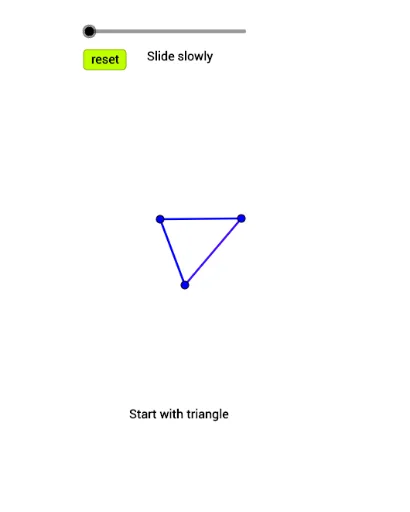
This example demonstrates constructing isosceles triangles and parallelograms on a triangle. Key mathematical concepts include the properties of isosceles triangles and parallelograms. Using GeoGebra commands such as Segment, LineBisector, Point, and Midpoint, these geometric shapes can be constructed. Suitable for middle school and above students to learn geometric construction and related properties.
GeoGebra Commands & Parameters
Segment(B, C) → gLineBisector(g) → pPoint(p) → FSegment(C, C + (t4 * (F - C))) → rSegment(A, B) → fMidpoint(f) → JSegment(C, A) → hLineBisector(h) → lPoint(l) → ELine(E, r) → m_1Segment(C, C + (t3 * (E - C))) → n_2Line(F, n_2) → n_1Intersect(m_1, n_1) → IMidpoint(I, C) → PLineBisector(f) → iPoint(i) → DMidpoint(h) → KSegment(B, B + (t4 * (F - B))) → qLine(D, q) → tSegment(B, B + (t2 * (D - B))) → jLine(F, j) → sIntersect(s, t) → GMidpoint(B, G) → OSegment(A, A + (t2 * (D - A))) → kPolygon(A, B, D) → poly1, d, a, bPolygon(A, E, C) → poly2, c, a_1, ePolygon(C, F, B) → poly3, b_1, c_1, f_1Segment(A, A + (t3 * (E - A))) → mLine(D, m) → i_1Line(E, k) → j_1Intersect(i_1, j_1) → HMidpoint(g) → LSegment(O, O + (t8 * (K - O))) → r_1Segment(P, P + (t8 * (J - P))) → s_1Intersect(r_1, s_1) → MMidpoint(E, D) → NSegment(D, D + (t5 * (G - D))) → h_1Segment(F, F + (t5 * (G - F))) → g_1Segment(F, F + (t6 * (I - F))) → p_1Segment(E, E + (t6 * (I - E))) → q_1Segment(D, D + (t7 * (H - D))) → l_1Segment(E, E + (t7 * (H - E))) → k_1Segment(N, N + (t8 * (L - N))) → t_1
AI Drawing Prompt Reference
Draw isosceles triangles and parallelograms on a triangle. Start by finding the perpendicular bisectors of the triangle's sides and marking their intersections. Then construct isosceles triangles and parallelograms using these points, ensuring they adhere to geometric properties. Further, connect specific points and extend lines to create additional shapes, ultimately forming a complex geometric pattern.
The prompt above was compiled from the original drawing commands and is for reference only.