
Investigating Rectangles
Loading the math board and drawing, please wait…
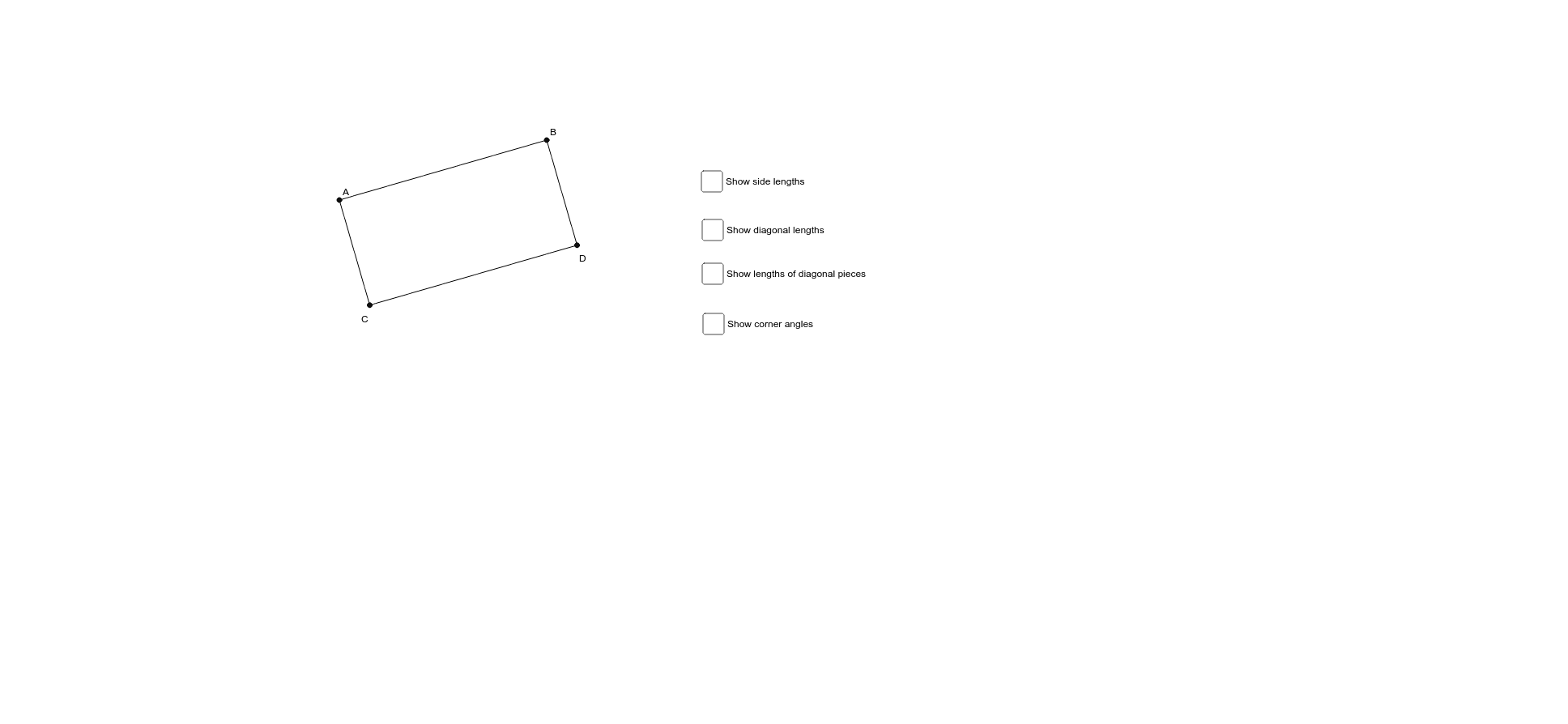
This example demonstrates how students can explore the properties of a rectangle. Key math concepts involved include line segments, orthogonal lines, points, lines, intersections, and angles. The construction utilizes GeoGebra commands such as Segment, OrthogonalLine, Point, Line, Intersect, and Angle. Suitable for middle school and above students to learn and understand the properties of plane figures.
GeoGebra Commands & Parameters
Segment(A, B) → aOrthogonalLine(B, a) → bOrthogonalLine(A, a) → cPoint(c) → CSegment(A, C) → dLine(C, a) → eIntersect(b, e) → DSegment(D, C) → fSegment(B, D) → gSegment(B, C) → hSegment(A, D) → iIntersect(h, i) → ESegment(B, E) → jSegment(C, E) → kSegment(A, E) → lSegment(E, D) → mAngle(C, A, B) → αAngle(A, B, D) → βAngle(B, D, C) → γAngle(D, C, A) → δSegment(A, C) → rSegment(C, D) → sSegment(D, B) → tSegment(B, A) → a_1
AI Drawing Prompt Reference
Draw a rectangle by starting with a line segment, then draw two perpendicular lines from one endpoint, intersecting at a point. Connect this point to the other endpoint of the segment. Draw two more lines to intersect the perpendicular lines, forming the rectangle. Label all four interior angles and sides.
The prompt above was compiled from the original drawing commands and is for reference only.