
Investigating Concurrence
Loading the math board and drawing, please wait…
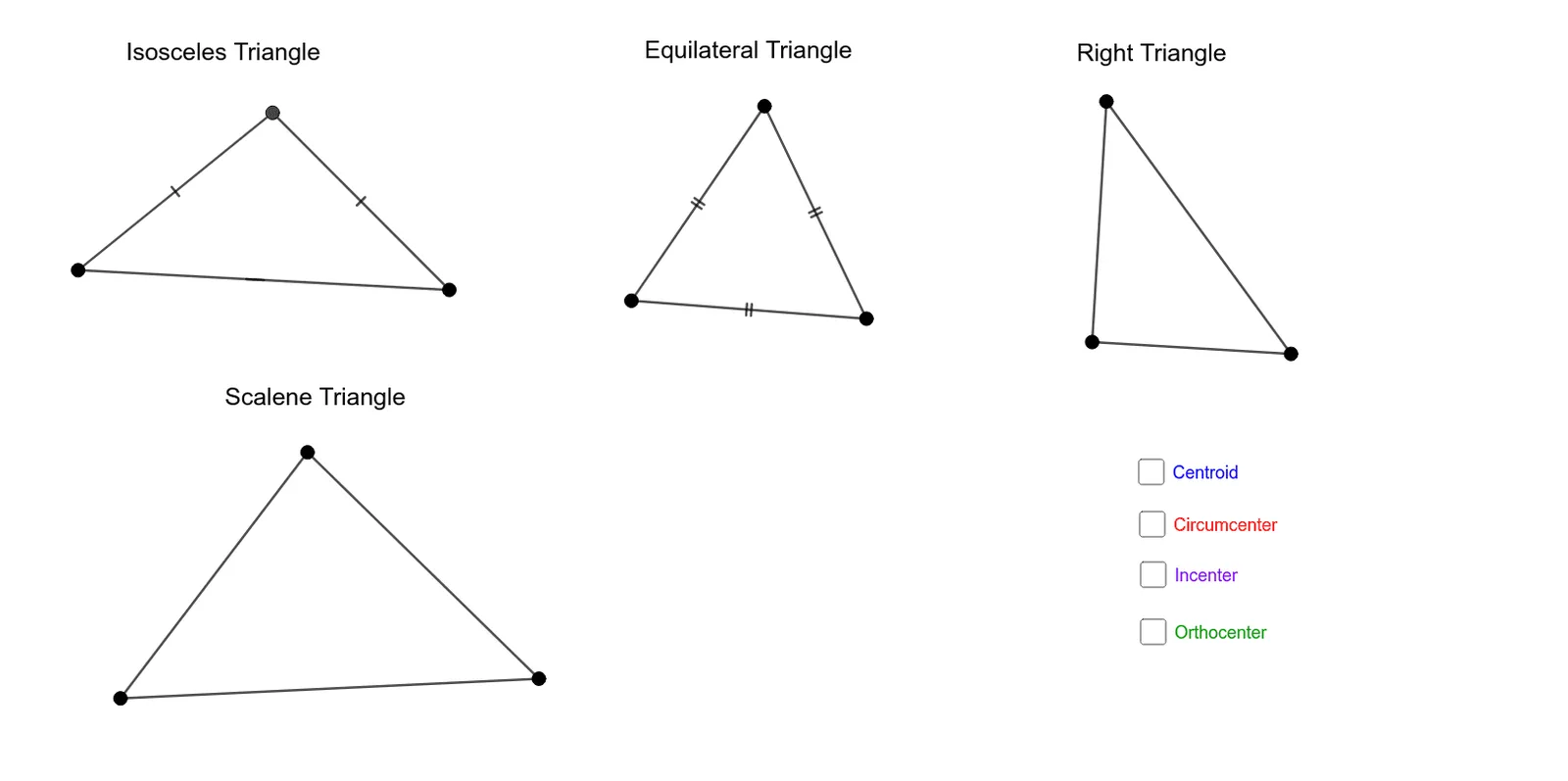
This example explores concurrence by constructing different types of triangles (isosceles, equilateral, right, scalene) and investigating the centroid, orthocenter, incenter, and circumcenter. Key mathematical concepts include the centroid, orthocenter, incenter, and circumcenter. Using GeoGebra commands such as Circle, Segment, Intersect, Point, OrthogonalLine, Midpoint, and AngularBisector, dynamic observations of these special points can be made. Suitable for high school geometry learners and educators.
GeoGebra Commands & Parameters
Circle(A, B) → cSegment(A, B) → fCircle(B, f) → dIntersect(c, d) → C, D, ,Segment(B, D) → gSegment(A, D) → hSegment(E, F) → iPoint(i) → GCircle(E, G) → eCircle(F, Segment[G, E]) → kIntersect(e, k) → H, I, ,Segment(E, H) → jSegment(F, H) → lSegment(J, K) → mOrthogonalLine(J, m) → nPoint(n) → LSegment(L, K) → pSegment(J, L) → qSegment(M, N) → rSegment(N, O) → sSegment(M, O) → tMidpoint(E, H) → PMidpoint(H, F) → QSegment(E, Q) → aSegment(F, P) → bMidpoint(E, F) → RSegment(H, R) → f_1Midpoint(B, D) → SMidpoint(D, A) → TMidpoint(B, A) → USegment(A, S) → g_1Segment(B, T) → h_1Segment(U, D) → i_1Midpoint(J, K) → VMidpoint(L, J) → WMidpoint(L, K) → ZSegment(J, Z) → j_1Segment(L, V) → k_1Segment(K, W) → l_1Midpoint(M, O) → A_1Midpoint(M, N) → B_1Midpoint(N, O) → C_1Segment(M, C_1) → m_1Segment(N, A_1) → n_1Segment(O, B_1) → p_1OrthogonalLine(P, j) → q_1OrthogonalLine(Q, l) → r_1OrthogonalLine(R, i) → s_1Intersect(q_1, i) → D_1Segment(P, D_1) → t_1Intersect(r_1, i) → E_1Segment(Q, E_1) → a_1Segment(D_1, R) → c_1Segment(R, H) → b_1OrthogonalLine(S, g) → d_1OrthogonalLine(T, h) → e_1OrthogonalLine(U, f) → f_2Segment(B, T) → g_2Segment(A, S) → h_2Segment(U, D) → i_2OrthogonalLine(W, q) → j_2OrthogonalLine(Z, p) → k_2OrthogonalLine(V, m) → l_2Segment(W, Z) → m_2Segment(V, Z) → n_2Intersect(k_2, m) → F_1Segment(Z, F_1) → p_2OrthogonalLine(B_1, r) → q_2OrthogonalLine(C_1, s) → r_2OrthogonalLine(A_1, t) → s_2Intersect(k_2, q) → G_1Segment(Z, G_1) → t_2Intersect(r_2, t) → H_1Intersect(q_2, t) → I_1Intersect(r, s_2) → J_1Intersect(r_2, r) → K_1Intersect(q_2, s) → L_1Intersect(s_2, s) → M_1Segment(C_1, H_1) → a_2Segment(I_1, B_1) → b_2Segment(J_1, A_1) → d_2Segment(K_1, C_1) → e_2Segment(A_1, M_1) → g_3Segment(K_1, C_1) → c_2Segment(B_1, L_1) → h_3Intersect(q_2, r_2) → N_1Segment(B_1, N_1) → f_3Segment(J_1, N_1) → i_3Segment(C_1, N_1) → j_3Segment(M_1, N_1) → k_3Intersect(r_1, s_1) → O_1Segment(P, O_1) → l_3Segment(H, O_1) → m_3Segment(Q, O_1) → n_3Intersect(g_2, h_2) → P_1AngularBisector(j, l) → p_3, q_3AngularBisector(j, i) → r_3, s_3AngularBisector(l, i) → t_3, a_3Intersect(a_3, j) → Q_1Intersect(r_3, l) → R_1Intersect(p_3, i) → S_1Segment(F, Q_1) → b_3Segment(E, R_1) → c_3Segment(H, S_1) → d_3Intersect(c_3, d_3) → T_1AngularBisector(B, D, A) → e_3AngularBisector(D, A, B) → f_4AngularBisector(A, B, D) → g_4Intersect(f_4, g) → U_1Intersect(g_4, h) → V_1Intersect(e_3, f) → W_1Segment(A, U_1) → h_4Segment(B, V_1) → i_4Segment(D, W_1) → j_4Intersect(j_4, h_4) → Z_1AngularBisector(J, L, K) → k_4AngularBisector(L, J, K) → l_4AngularBisector(L, K, J) → m_4Intersect(m_4, q) → A_2Intersect(l_4, p) → B_2Intersect(k_4, m) → C_2Segment(L, C_2) → n_4Segment(J, B_2) → p_4Segment(K, A_2) → q_4AngularBisector(O, M, N) → r_4AngularBisector(M, N, O) → s_4AngularBisector(N, O, M) → t_4Intersect(s_4, t) → D_2Intersect(r_4, s) → E_2Intersect(t_4, r) → F_2Segment(O, F_2) → a_4Segment(N, D_2) → b_4Segment(M, E_2) → c_4Intersect(a_4, c_4) → G_2Intersect(p_4, n_4) → H_2OrthogonalLine(H, i) → d_4OrthogonalLine(E, l) → e_4OrthogonalLine(F, j) → f_5Intersect(f_5, e_4) → I_2Segment(F, I_2) → g_5Segment(E, I_2) → h_5Segment(R, I_2) → i_5OrthogonalLine(B, h) → j_5OrthogonalLine(A, g) → k_5OrthogonalLine(D, f) → l_5Intersect(k_5, g) → J_2Intersect(l_5, f) → K_2Intersect(j_5, h) → L_2Segment(D, K_2) → m_5Segment(B, L_2) → n_5Segment(A, J_2) → p_5Segment(L, J) → q_5Segment(J, K) → r_5OrthogonalLine(J, p) → s_5Intersect(s_5, p) → M_2Segment(J, M_2) → t_5OrthogonalLine(N, t) → a_5OrthogonalLine(O, r) → b_5OrthogonalLine(M, s) → c_5Intersect(b_5, a_5) → N_2Intersect(b_5, r) → O_2Intersect(c_5, s) → P_2Intersect(a_5, t) → Q_2Segment(O, N_2) → d_5Segment(O, O_2) → e_5Segment(M, N_2) → f_6Segment(M, P_2) → g_6Segment(Q_2, N_2) → h_6Segment(Q_2, N) → i_6Intersect(m_5, p_5) → R_2Intersect(a, f_1) → S_2Intersect(i_1, g_1) → T_2Intersect(k_1, l_1) → U_2Intersect(n_1, p_1) → V_2Intersect(m_2, n_2) → W_2
AI Drawing Prompt Reference
Construct a geometric diagram exploring concurrence in triangles. Start with an equilateral triangle, then a scalene triangle. For each triangle, draw the medians connecting vertices to midpoints of opposite sides, all intersecting at the centroid. Draw altitudes from each vertex perpendicular to the opposite side, meeting at the orthocenter. Construct angle bisectors from each vertex, converging at the incenter. Draw perpendicular bisectors of each side, intersecting at the circumcenter. Use distinct colors or line styles to differentiate these special points and their connecting lines, allowing visual comparison of their concurrency.
The prompt above was compiled from the original drawing commands and is for reference only.