
Inner Triangle Formed by Connecting Trisection Points
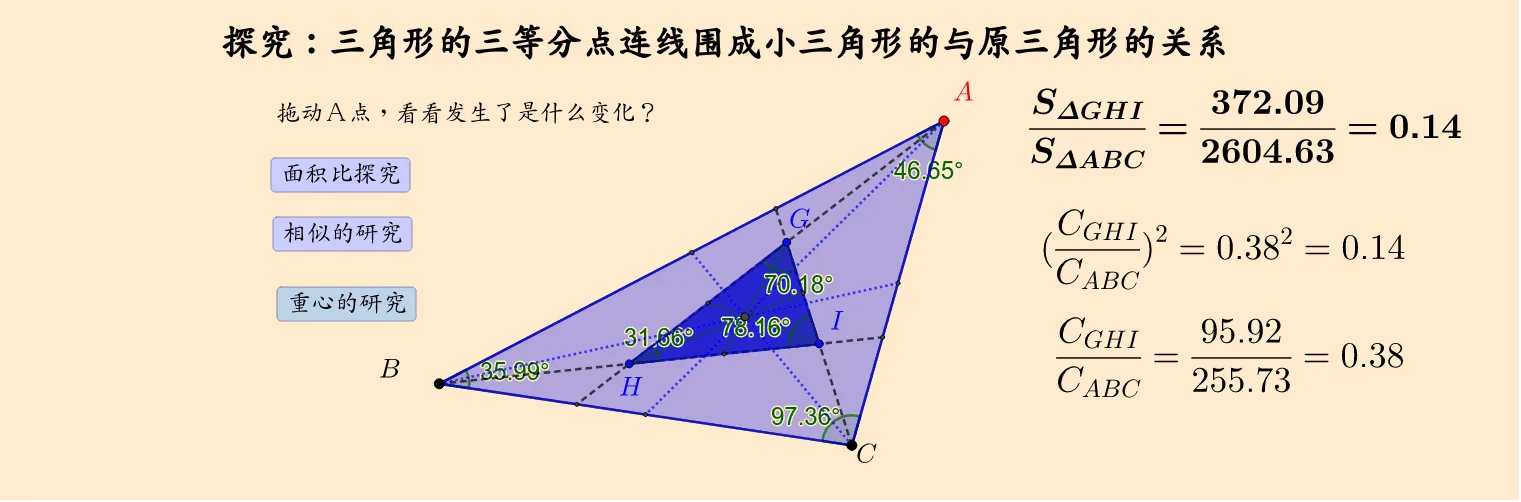
This example demonstrates constructing an inner triangle by marking trisection points on each side of triangle ABC and connecting each vertex to the two trisection points on the opposite side. The three main connecting lines intersect pairwise to form a smaller interior triangle GHI. Using GeoGebra's dynamic construction, users can measure area ratios, interior angles, centroids, and other geometric quantities of both the outer and inner triangles, visually exploring classical geometric properties related to triangle subdivision. By dragging the vertices of triangle ABC, students can observe how the configuration transforms while preserving its underlying invariant relationships. The applet highlights the elegant result that the area of the inner triangle GHI is exactly one-seventh of the area of the original triangle ABC, a beautiful theorem known as the one-seventh area triangle or Moser's triangle problem. This interactive tool allows learners to verify this striking ratio through direct measurement and manipulation, reinforcing the connection between geometric intuition and rigorous proof. The construction also enables exploration of the coordinates of the intersection points, the behavior of medians and cevians, and the relationship between the centroid of the original triangle and the inner triangle. Teachers can use this applet in classroom settings to guide students through inquiry-based learning, asking them to conjecture properties before deriving them algebraically or synthetically. The dynamic nature of the visualization makes abstract concepts tangible, helping students build deeper understanding of triangle geometry, cevian configurations, and area ratios. This applet is particularly valuable for advanced high school geometry courses, competition mathematics preparation, and undergraduate geometry explorations.
In collections
Lumei Junior High Geometry Models
Loading the math board and drawing, please wait…