
Hexagon Angle Theorems: Interior and Exterior Sums
Loading the math board and drawing, please wait…
In collections
Polygons & Angles
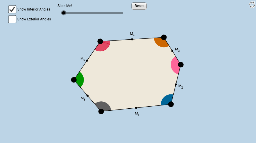
This interactive GeoGebra applet allows students to discover the sum of interior angles and the sum of exterior angles of a hexagon through dynamic manipulation. The core mathematical concepts include the polygon interior angle sum formula (n-2)×180° and the invariant exterior angle sum of 360° for any convex polygon. Users can drag vertices to observe how individual angles change while the sums remain constant. The construction employs commands such as Circle, Ray, Intersect, Segment, Vector, Translate, Dilate, Polygon, Point, Midpoint, Rotate, Line, and CircleArc, along with objects like A_1, D, C, h, c, P, A, B, a, b, E, e, f, g, k, p, i, j, F, G, H, I, J, K, O, Q, R, S, T, U, V, q, r, s, c_1, d_1, W, h_1, p_1, q_1. It is suitable for middle school geometry lessons, enabling inquiry-based learning of angle theorems, and also serves as a visual aid for high school review of polygon properties.
GeoGebra Commands & Parameters
Circle(C, 1.5) → hRay(C, D) → cIntersect(h, c, 1) → PRay(A, B) → aRay(B, C) → bRay(E, A) → eCircle(A, 1.5) → fCircle(B, 1.5) → gCircle(D, 1.5) → kCircle(E, 1.5) → pSegment(C, A) → iSegment(C, E) → jIntersect(f, a, 1) → FIntersect(f, i, 1) → GIntersect(f, e, 1) → HIntersect(f, e, 2) → IIntersect(p, e) → J,Intersect(p, j) → K,Intersect(k, c, 2) → OIntersect(h, j, 1) → QIntersect(h, i, 1) → RIntersect(h, b, 1) → SIntersect(g, a, 2) → TIntersect(g, b, 1) → UIntersect(g, a, 1) → VCircleSector(A, F, G) → qCircleSector(A, G, H) → rCircleSector(B, U, V) → sCircleSector(C, Q, R) → c_1CircleSector(C, R, S) → d_1Intersect(k, c, 1) → WCircleSector(E, J, K) → h_1CircleSector(A, I, F) → p_1CircleSector(B, T, U) → q_1Intersect(h, b, 2) → ZCircleSector(C, Z, P) → r_1Vector(A, B) → uVector(C, B) → vVector(E, D) → wVector(C, D) → u_1Vector(C, E) → v_1Vector(A, E) → w_1Translate(d_1, v) → s_1Dilate(C, If[1 < l ≤ 2, 2 - l, 0], E) → C'_1Dilate(C, If[2 < l ≤ 3, 3 - l, 0], D) → C'_2Dilate(E, If[2 < l ≤ 3, 3 - l, 0], D) → E'Vector(A, B) → a_1Vector(E, E') → j_1Vector(C, C'_2) → l_1Vector(C, C'_1) → m_1Translate(r, w_1) → r'_2Translate(c_1, v_1) → f_2Translate(c_1, m_1) → g_2Translate(q, a_1) → r'Vector(D, C) → u_2Vector(E, C) → v_2Vector(A, C) → w_2Vector(B, C) → l_2Dilate(B, If[0 < o < 1, 1 - o, 0], C) → B'Dilate(A, If[1 < o < 2, 2 - o, 0], C) → A'_2Dilate(E, If[2 < o < 3, 3 - o, 0], C) → E'_1Dilate(D, If[3 < o < 4, 4 - o, 0], C) → D'Vector(B, B') → m_2Vector(A, A'_2) → n_2Vector(E, E'_1) → s_2Vector(D, D') → t_2Translate(q_1, m_2) → c_3Translate(q_1, l_2) → d_3Translate(p_1, w_2) → e_3If(1 < o < 2, Translate[p_1, n_2]) → h_3Ray(D, A_1) → a_3Ray(A_1, E) → b_3Circle(A_1, 1.5) → q_3Intersect(q_3, b_3, 1) → NIntersect(q_3, a_3, 2) → B_1Intersect(k, c, 2) → C_1Intersect(k, a_3, 1) → D_1Intersect(k, c, 1) → E_1Intersect(p, b_3, 1) → F_1Dilate(C, If[2 < l < 3, 3 - l, 0], A_1) → C'_3Vector(E, A_1) → f_1Vector(C, A_1) → g_1Vector(C, C'_3) → b_2Intersect(q_3, a_3, 1) → I_1CircleSector(D, D_1, E_1) → k_3Vector(C, D) → j_2Vector(A_1, D) → u_3Intersect(p, b_3, 2) → J_1Polygon(A, B, C) → poly1, c_4, a_4, b_4Polygon(A, C, E) → poly2, e_4, a_5, c_5Polygon(E, C, A_1) → poly3, a_6, e_5, c_6Polygon(A_1, C, D) → poly4, d_4, a_7, c_7Polygon(A, B, C, D, A_1, E) → poly5, a_8, b_5, c_8, d_5, a_9, e_6Intersect(e, e_6) → K_1Intersect(p, e, 1) → L_1CircleSector(E, J_1, L_1) → f_4CircleSector(A_1, B_1, N) → g_4CircleSector(D, C_1, D_1) → h_4Vector(E, C) → j_3Vector(A_1, C) → l_3Vector(D, C) → m_3Translate(f_4, j_3) → k_4Translate(g_4, l_3) → p_4Translate(h_4, m_3) → q_4Dilate(E, If[2 < o < 3, 3 - o, 0], C) → E'_3Dilate(A_1, If[3 < o < 4, 4 - o, 0], C) → M_7Dilate(D, If[4 < o < 5, 5 - o, 0], C) → D'_1Vector(E, E'_3) → n_3Vector(A_1, M_7) → u_4Vector(D, D'_1) → v_4If(2 < o < 3, Translate[f_4, n_3]) → r_4If(3 < o < 4, Translate[g_4, u_4]) → s_4If(4 < o < 5, Translate[h_4, v_4]) → t_4Ray(C, A_1) → l_4Ray(C, E) → m_4Point(l_4) → N_1Point(m_4) → O_1Segment(D, C) → n_4Segment(C, B) → f_5Segment(B, A) → g_5Segment(A, E) → h_5Segment(E, A_1) → i_5Segment(A_1, D) → j_5Midpoint(f_5) → M_2Midpoint(g_5) → M_1Rotate(d_1, If[0 < l ≤ 1, (((-l) * 180))°, -180°], M_2) → dRotate(C, If[0 < l ≤ 1, (((-l) * 180))°, -180°], M_2) → C'Segment(M_2, C') → tRotate(q, If[0 < l ≤ 1, ((l * 180))°, 180°], M_1) → q'Rotate(A, If[0 < l ≤ 1, ((l * 180))°, 180°], M_1) → A'Segment(M_1, A') → e_1Rotate(R, 180°, M_2) → R'Line(B, R') → k_1Ray(E, O_1) → i_1Midpoint(h_5) → M_6Rotate(r, If[1 < l ≤ 2, (((-(l - 1)) * 180))°, -180°], M_6) → r'_1Rotate(A, If[1 < l ≤ 2, (((-(l - 1)) * 180))°, -180°], M_6) → A'_1Segment(M_6, A'_1) → n_1CircleSector(E, K, F_1) → c_2Midpoint(i_5) → M_5Rotate(E, If[2 < l ≤ 3, (((-(l - 2)) * 180))°, -180°], M_5) → E'_2Segment(M_5, E'_2) → a_2Rotate(c_2, If[2 < l ≤ 3, (((-(l - 2)) * 180))°, -180°], M_5) → d_2Segment(A_1, C) → e_2Intersect(h, e_2, 1) → U_1CircleSector(C, U_1, Q) → h_2CircleSector(C, P, U_1) → k_2Vector(C, C'_3) → t_1Translate(h_2, t_1) → p_2Intersect(q_3, e_2, 1) → R_1CircleSector(A_1, N, R_1) → q_2CircleSector(A_1, R_1, I_1) → r_2Vector(C, A_1) → i_2Translate(U_1, i_2) → S_1Ray(A_1, S_1) → f_3Midpoint(j_5) → M_4Midpoint(n_4) → M_3Rotate(k_2, If[3 < l ≤ 4, (((l - 3) * 180))°, 180°], M_3) → g_3Rotate(C, If[3 < l ≤ 4, (((l - 3) * 180))°, 180°], M_3) → C'_4Rotate(U_1, 180°, M_3) → W_1Segment(M_3, C'_4) → i_3Rotate(r_2, If[3 < l ≤ 4, (((-(l - 3)) * 180))°, -180°], M_4) → p_3Rotate(A_1, If[3 < l ≤ 4, (((-(l - 3)) * 180))°, -180°], M_4) → Z_1Segment(M_4, Z_1) → r_3Line(D, W_1) → s_3CircleArc(C, R, S) → t_3CircleArc(A, F, G) → k_5CircleArc(C, Q, R) → p_5CircleArc(A, G, H) → q_5CircleArc(C, U_1, Q) → r_5CircleArc(E, K, F_1) → s_5CircleArc(C, P, U_1) → t_5CircleArc(A_1, R_1, I_1) → d_6