
H-Kite-Filtered
Loading the math board and drawing, please wait…
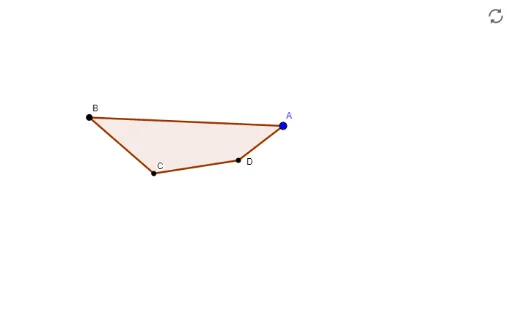
This example demonstrates the filtering process of H-kite. Key mathematical concepts include geometric transformations and random variables. Using GeoGebra commands such as Circle, Segment, OrthogonalLine, Line, Polygon, Intersect, etc., a kite can be constructed and filtered. Suitable for high school geometry and probability statistics courses.
GeoGebra Commands & Parameters
Circle(B, C) → fCircle(D, C) → gSegment(B, D) → f_1OrthogonalLine(C, f_1) → i_1Line(B, C) → aPolygon(B, C, D, A) → poly1, b, c, c_1, a_1Line(B, c) → dLine(D, b) → eCircle(C, D) → hCircle(C, B) → kCircle(B, Distance[C, D]) → qIntersect(d, e) → GCircle(D, G) → pIntersect(q, e) → E, FIntersect(p, d) → H, IIntersect(g, d) → J, KIntersect(g, e) → L, MOrthogonalLine(D, d) → iIntersect(i, d) → NOrthogonalLine(B, e) → jIntersect(j, e) → ORay(B, F) → lRay(D, F) → mCircle(N, 0.3) → g_1Circle(O, 0.3) → h_1Circle(I, 0.3) → tCircle(E, 0.3) → sCircle(G, 0.3) → rDistance(A, i_1) → DaltdistDistance(A, H) → MakdistIf(Makdist < 0.25, true) → IsRhumDistance(A, I) → ADeqBCdistDistance(A, E) → ABeqCDdistMin(Distance[A, O], Distance[A, N]) → BAD90distDistance(A, l) → CDparABdistDistance(A, m) → CBparADdistCircle(C, B) → e_1Distance(A, f_1) → tridistIf(Daltdist < 0.25 ∧ tridist > 0.1 ∧ Distance[A, C] > 0.1, true) → IsDaltIf((CBparADdist < 0.2 ∨ CDparABdist < 0.2) ∧ Makdist > 0.2, true) → Istrap
AI Drawing Prompt Reference
Draw an H-kite by first drawing circles with centers at B, C, D, and C, then drawing segment BD, and the orthogonal line i1 to BD. Next, draw quadrilateral BCDA and extend lines BC and BD. Then, draw circles with centers at C, D, and a circle with radius equal to the distance between C and D. Find the intersection points G, E, F, H, I, J, K, L, M, N, and O. Draw the orthogonal lines i and j to BD and BC, and then draw small circles centered at these intersection points. Finally, use distance conditions to determine if it is a rhombus, right trapezoid, or isosceles trapezoid.
The prompt above was compiled from the original drawing commands and is for reference only.