
Guess the Sort: Interactive Number Classification Game
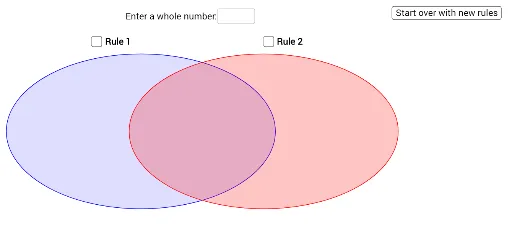
Loading the math board and drawing, please wait…
This is an interactive math game demonstrating how to identify sorting rules for number sets through guessing and feedback. Core mathematical concepts include number classification (prime, composite, odd, even), interval partitioning, set operations, and conditional logic. Construction highlights: uses GeoGebra commands such as RandomElement and Random to generate random number lists, KeepIf, Remove, and Flatten to filter and organize data, Textfield and InputBox1 to create user input interfaces, If, Intersection, and RemoveUndefined to check whether user guesses match preset rules, and TableText to display results. Suitable for middle school math classes or self-study, this example trains students' observation and reasoning skills about number properties while experiencing programming-style mathematical modeling.
GeoGebra Commands & Parameters
RandomElement({10, 100}) → roundsTypeRandom(0, 10) → roundsNumberKeepIf((round(a / roundsType) * roundsType) ≟ (roundsNumber * roundsType), a, guesses) → roundsListKeepIf(floor(a / 12) ≟ a / 12, a, guesses) → twelveListKeepIf(floor(a / 11) ≟ a / 11, a, guesses) → elevenListKeepIf(floor(a / 10) ≟ a / 10, a, guesses) → tenListKeepIf(floor(a / 9) ≟ a / 9, a, guesses) → nineListKeepIf(floor(a / 8) ≟ a / 8, a, guesses) → eightListKeepIf(floor(a / 7) ≟ a / 7, a, guesses) → sevenListKeepIf(floor(a / 6) ≟ a / 6, a, guesses) → sixListKeepIf(floor(a / 5) ≟ a / 5, a, guesses) → fiveListKeepIf(floor(a / 4) ≟ a / 4, a, guesses) → fourListKeepIf(floor(a / 3) ≟ a / 3, a, guesses) → threeListRandom(5, 100) → aboveBelowNumberKeepIf(a < aboveBelowNumber, a, guesses) → belowListKeepIf(a > aboveBelowNumber, a, guesses) → aboveListKeepIf(IsPrime[q], q, guesses) → primeListRemove(guesses, Join[{primeList, {1, 0}}]) → compositeListKeepIf(floor(x / 2 + 1 / 2) ≟ x / 2 + 1 / 2, guesses) → oddListKeepIf(floor(x / 2) ≟ x / 2, guesses) → evenListFlatten({"rounds", RandomElement[{"even", "odd"}], RandomElement[{"prime", "composite"}], First[Shuffle[{"3", "4", "5", "6", "7", "8", "9", "10", "11", "12"}], 4], RandomElement[{"above", "below"}]}) → rulesRandomElement(rules) → rule1RandomElement(Remove[rules, {rule1}]) → rule2Textfield(guessText) → InputBox1If(guess < 0, true, If[IsInteger[guess], false, true]) → warningIf(rule2 ≟ "prime", primeList, If[rule2 ≟ "composite", compositeList, If[rule2 ≟ "even", evenList, If[rule2 ≟ "odd", oddList, If[rule2 ≟ "even", evenList, If[rule2 ≟ "3", threeList, If[rule2 ≟ "4", fourList, If[rule2 ≟ "5", fiveList, If[rule2 ≟ "6", sixList, If[rule2 ≟ "7", sevenList, If[rule2 ≟ "8", eightList, If[rule2 ≟ "9", nineList, If[rule2 ≟ "10", tenList, If[rule2 ≟ "11", elevenList, If[rule2 ≟ "12", twelveList, If[rule2 ≟ "above", aboveList, If[rule2 ≟ "below", belowList, If[rule2 ≟ "rounds", roundsList, {}]]]]]]]]]]]]]]]]]) → rule2HelperListIf(rule1 ≟ "prime", primeList, If[rule1 ≟ "composite", compositeList, If[rule1 ≟ "even", evenList, If[rule1 ≟ "odd", oddList, If[rule1 ≟ "even", evenList, If[rule1 ≟ "3", threeList, If[rule1 ≟ "4", fourList, If[rule1 ≟ "5", fiveList, If[rule1 ≟ "6", sixList, If[rule1 ≟ "7", sevenList, If[rule1 ≟ "8", eightList, If[rule1 ≟ "9", nineList, If[rule1 ≟ "10", tenList, If[rule1 ≟ "11", elevenList, If[rule1 ≟ "12", twelveList, If[rule1 ≟ "above", aboveList, If[rule1 ≟ "below", belowList, If[rule1 ≟ "rounds", roundsList, {}]]]]]]]]]]]]]]]]]) → rule1HelperListIntersection(rule1HelperList, rule2HelperList) → intersectionListRemove(rule1HelperList, intersectionList) → rule1ListRemove(rule2HelperList, intersectionList) → rule2ListRemove(guesses, Join[{rule1List, rule2List, intersectionList}]) → excludedListRemoveUndefined(Sequence[RemoveUndefined[Sequence[Element[rule1List, i], i, 1 + (4 * j), 4 + (4 * j)]], j, 0, ceil(Length[rule1List / 4])]) → r1ListTableText(r1List) → text8RemoveUndefined(Sequence[RemoveUndefined[Sequence[Element[rule2List, i], i, 1 + (4 * j), 4 + (4 * j)]], j, 0, ceil(Length[rule2List / 4])]) → r2ListRemoveUndefined(Sequence[RemoveUndefined[Sequence[Element[excludedList, i], i, 1 + (4 * j), 4 + (4 * j)]], j, 0, ceil(Length[excludedList / 4])]) → ELRemoveUndefined(Sequence[RemoveUndefined[Sequence[Element[intersectionList, i], i, 1 + (4 * j), 4 + (4 * j)]], j, 0, ceil(Length[intersectionList / 4])]) → ILTableText(r2List) → text5TableText(IL) → text6TableText(EL) → text7
AI Drawing Prompt Reference
Create an interactive number classification game where the user needs to guess numbers based on given rules. First, randomly generate a number between 10 and 100, then create lists of numbers that meet specific criteria such as even, odd, prime, composite, etc. The user inputs a guess, and the system filters the lists according to the rules, showing numbers that match the criteria and providing feedback. Finally, display all the lists of numbers that match the criteria, including even, odd, prime, composite, etc.
The prompt above was compiled from the original drawing commands and is for reference only.