
Graphing Rational Numbers on a Number Line by Celia Jimenez
Loading the math board and drawing, please wait…
In collections
Jessica's Fraction Book
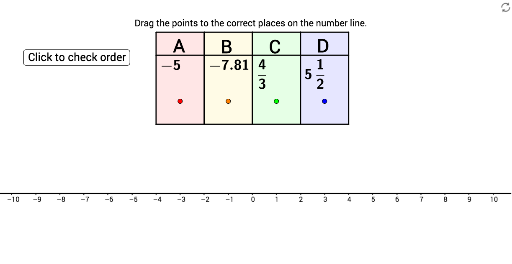
This example demonstrates how to accurately place rational numbers on a number line. Key mathematical concepts include the properties of rational numbers and their representation on a number line. Using GeoGebra commands such as RandomElement, If, and Polygon, the example dynamically shows the positions of rational numbers. Suitable for students in middle school and above to learn about rational numbers.
GeoGebra Commands & Parameters
RandomElement({2, 3, 4, 5, 6, 7, 8, 9, 10, 11, 12}) → CdenomIf(Cdenom ≟ 2, Random[-20, 20, true], If[Cdenom ≟ 3, Random[-30, 30, true], If[Cdenom ≟ 4, Random[-40, 40, true], If[Cdenom ≟ 5, Random[-50, 50, true], If[Cdenom ≟ 6, Random[-60, 60, true], If[Cdenom ≟ 7, Random[-70, 70, true], If[Cdenom ≟ 8, Random[-80, 80, true], If[Cdenom ≟ 9, Random[-90, 90, true], If[Cdenom ≟ 10, Random[-100, 100, true], If[Cdenom ≟ 11, Random[-110, 110, true], If[Cdenom ≟ 12, Random[-120, 120, true]]]]]]]]]]]) → CnumPolygon(I, W, V, J) → poly1, i, w, v, jPolygon(J, V, U, K) → poly2, j_1, v_1, u, kPolygon(K, U, T, L) → poly3, k_1, u_1, t, lPolygon(L, T, S, M) → poly4, l_1, t_1, s, mSegment(H, G) → cSegment(G, Z) → dSegment(Z, E) → eSegment(E, F) → fFractionText(C) → CfancyRandomElement({2, 3, 4, 5, 6, 7, 8, 9, 10, 11, 12}) → DdenomRandomElement({-9, -8, -7, -6, -5, -4, -3, -2, -1, 1, 2, 3, 4, 5, 6, 7, 8, 9}) → DwholeRandom(1, Ddenom - 1, true) → DnumFractionText(Dnum / Ddenom) → DfancyIf(Dwhole < 0, Dwhole - Dnum / Ddenom, Dwhole + Dnum / Ddenom) → DSegment(A_1, Aact) → aerrSegment(B_1, Bact) → berrSegment(C_1, Cact) → cerrSegment(D_1, Dact) → derrSort({A, B, C, D}) → testSort({x(A_1), x(B_1), x(C_1), x(D_1)}) → test2If(IndexOf[A, Sort[{A, B, C, D}]] ≟ IndexOf[x(A_1), Sort[{x(A_1), x(B_1), x(C_1), x(D_1)}]], 1) → orderAIf(IndexOf[B, Sort[{A, B, C, D}]] ≟ IndexOf[x(B_1), Sort[{x(A_1), x(B_1), x(C_1), x(D_1)}]], 1) → orderBIf(IndexOf[C, Sort[{A, B, C, D}]] ≟ IndexOf[x(C_1), Sort[{x(A_1), x(B_1), x(C_1), x(D_1)}]], 1) → orderCIf(IndexOf[D, Sort[{A, B, C, D}]] ≟ IndexOf[x(D_1), Sort[{x(A_1), x(B_1), x(C_1), x(D_1)}]], 1) → orderD
AI Drawing Prompt Reference
Draw rational numbers on a number line, showing the positions of randomly generated rational numbers with different denominators. First, draw the number line, then mark the points of the rational numbers randomly generated on the number line, connect these points with colored line segments, and finally arrange these points in order, labeling each rational number with a text tag.
The prompt above was compiled from the original drawing commands and is for reference only.