
Geometric Construction of Square Roots via the Pythagorean Theorem
Loading the math board and drawing, please wait…
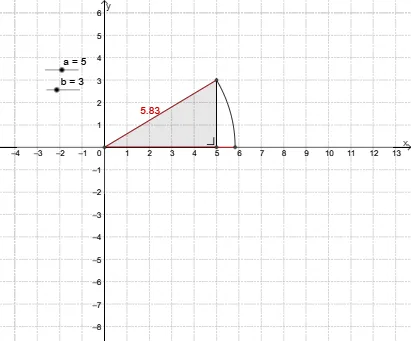
This GeoGebra example demonstrates how to construct a square root using a purely geometric setup based on the Pythagorean theorem. By building a right-angled triangle and enforcing c^2 = a^2 + b^2, it turns the algebraic act of taking a square root into locating a segment whose length corresponds to the desired √(·) value. Key concepts include the Pythagorean theorem, perpendicular (orthogonal) lines to create right angles, and the use of circles to transfer known lengths into new, computable distances. Construction workflow: Intersect is used to locate critical points from circle-line relationships; Circle and CircleArc provide circles with radii determined by given segments; Segment connects points to form the triangle sides; OrthogonalLine creates the right angle constraint; Angle and Polygon help define and keep the intended geometric configuration. The labeled points (e.g., a, b, A, B, C, …) represent the intermediate construction anchors, culminating in the segment that encodes the square root length. Suitable for secondary school geometry lessons, enrichment activities, and interactive demonstrations linking algebraic radicals to classical geometric construction.
GeoGebra Commands & Parameters
Intersect(xAxis, yAxis) → ACircle(A, a) → cIntersect(c, xAxis) → B, CSegment(A, C) → dOrthogonalLine(C, xAxis) → eCircle(C, b) → fIntersect(f, e) → D, ESegment(E, A) → gCircle(A, E) → hIntersect(h, xAxis) → F, GSegment(E, C) → iSegment(C, A) → jAngle(E, C, A) → αSegment(A, G) → kCircleArc(A, G, E) → pPolygon(A, C, E) → veelhoek1, e_1, a_1, c_1
AI Drawing Prompt Reference
Construct a right triangle with one leg of length a and hypotenuse of length b. Use circles and perpendicular lines to find the length of the other leg, which represents √(a^2 + b^2). Start by drawing a circle at the intersection of the axes, then use perpendicular lines and circle intersections to locate new points, connect these points to form the triangle, and finally determine the leg length using angles and arcs.
The prompt above was compiled from the original drawing commands and is for reference only.