
Geometric Construction Example by HeMan123
Loading the math board and drawing, please wait…
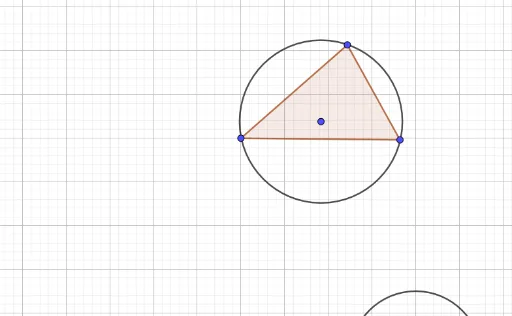
This example demonstrates how to construct geometric figures using GeoGebra commands, involving core math concepts like integers, probability, trigonometric functions, coordinate geometry, and equilateral triangles. Construction highlights include using commands such as Segment, Circle, Intersect, Rotate, Angle, Ray, and Polygon; suitable for middle school and above learning geometric constructions and coordinate geometry.
GeoGebra Commands & Parameters
Segment(A, B) → fCircle(A, B) → c_1Circle(B, A) → d_1Intersect(c_1, d_1, 1) → CSegment(C, A) → g_1Segment(B, C) → h_1Rotate(D, 60°, E) → D'Angle(D, E, D') → αSegment(D, E) → iSegment(E, D') → jCircle(E, 4) → e_1Intersect(e_1, i, 1) → FIntersect(e_1, j, 1) → GCircle(F, 4) → kCircle(G, 4) → pIntersect(k, p, 2) → HSegment(H, E) → lRotate(b_1, 25°, a_1) → c_2Angle(b_1, a_1, c_2) → βSegment(b_1, a_1) → mSegment(c_2, a_1) → nCircle(a_1, 3) → qIntersect(q, m, 1) → d_2Intersect(q, n, 1) → e_2Ray(g, h) → rCircle(g, 3) → sIntersect(s, r, 1) → ISegment(d_2, e_2) → tCircle(I, 1.3) → f_1Intersect(s, f_1, 1) → JRay(g, J) → i_1Segment(a_2, b_2) → j_1Circle(a_2, 10.088889039873256) → k_1Circle(b_2, 9.877200634618088) → p_1Intersect(k_1, p_1, 1) → d_3Intersect(k_1, p_1, 2) → c_3Segment(d_3, c_3) → l_1Intersect(j_1, l_1) → eSegment(K, L) → m_1Circle(K, 5.047389082576646) → q_1Circle(L, 5.148910498455693) → r_1Intersect(q_1, r_1, 1) → MIntersect(q_1, r_1, 2) → NSegment(M, N) → n_1Intersect(m_1, n_1) → OCircle(M, 4.353709594752132) → s_1Circle(O, 4.395072539574817) → t_1Intersect(s_1, t_1, 2) → PIntersect(s_1, t_1, 1) → QSegment(P, Q) → f_2Polygon(a, b, c) → t1, t_2, r_2, s_2Circle(a, 4.9119295041113675) → g_2Circle(b, 5.204069650512864) → h_2Circle(c, 4.898031168081163) → k_2Intersect(g_2, k_2, 1) → UIntersect(g_2, k_2, 2) → VSegment(U, V) → i_2Intersect(h_2, k_2, 2) → WIntersect(h_2, k_2, 1) → ZSegment(W, Z) → j_2Intersect(g_2, h_2, 2) → A_1Segment(c, A_1) → l_2Intersect(i_2, j_2) → dPolygon(R, S, T) → t2, t_3, r_3, s_3Circle(B_1, Radius[Circle[T, R, S]]) → p_2Circle(c, a, C_1) → q_2