
Generalization of the Angle Bisector Theorem
Loading the math board and drawing, please wait…
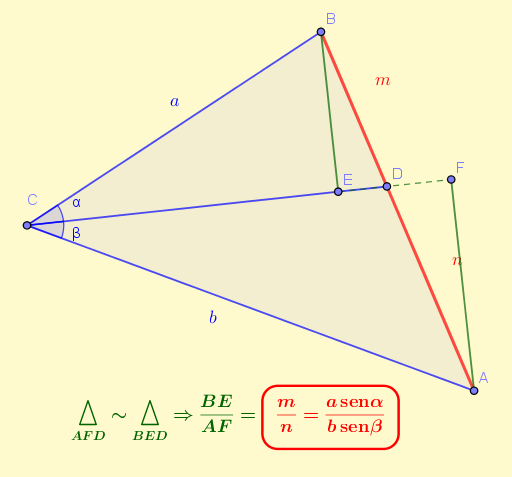
This example demonstrates the generalization of the angle bisector theorem for any cevian in terms of the angles it forms with the adjacent sides. Key mathematical concepts include triangles, trigonometry, and angles. It utilizes commands such as Polygon, Point, Ray, OrthogonalLine, Intersect, Segment, and Angle in GeoGebra. Suitable for high school mathematics education and learning.
GeoGebra Commands & Parameters
Polygon(A, B, C) → t1, c, a, bPoint(c) → DRay(C, D) → fOrthogonalLine(B, f) → gOrthogonalLine(A, f) → hIntersect(g, f) → EIntersect(h, f) → FSegment(C, D) → iSegment(E, F) → jSegment(A, D) → nSegment(D, B) → mSegment(B, E) → kSegment(F, A) → lAngle(A, C, F) → βAngle(F, C, B) → α
AI Drawing Prompt Reference
Draw a triangle with vertices A, B, and C. Choose a point D and draw the ray starting at C and passing through D as the main cevian/reference line. Construct two lines perpendicular to this ray: one through B meeting the ray at E, and one through A meeting the ray at F. Draw the segments CD, EF, AD, DB, BE, and FA. Finally, mark the angle at C between A and F, and the angle at C between F and B, to illustrate the generalized angle-bisector relationship for this cevian.
The prompt above was compiled from the original drawing commands and is for reference only.