
Fractions as Parts of Circles
Loading the math board and drawing, please wait…
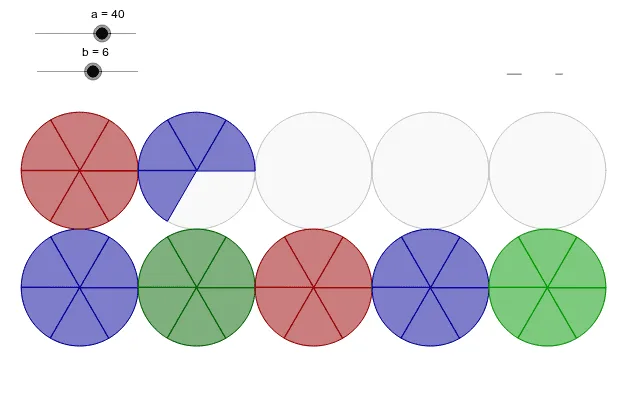
This example demonstrates how fractions represent parts of a circle. Key mathematical concepts include circles, fractions, and geometry. Using GeoGebra commands such as If and Sequence, multiple circles and fraction representations of arcs are constructed. Suitable for middle school and above students to learn geometric concepts.
GeoGebra Commands & Parameters
If(a - ((A1 - 1) * b) > 0, If[a - ((A1 - 1) * b) < b, a - ((A1 - 1) * b), b], 0) → B1If(a - ((A2 - 1) * b) > 0, If[a - ((A2 - 1) * b) < b, a - ((A2 - 1) * b), b], 0) → B2If(a - ((A3 - 1) * b) > 0, If[a - ((A3 - 1) * b) < b, a - ((A3 - 1) * b), b], 0) → B3If(a - ((A4 - 1) * b) > 0, If[a - ((A4 - 1) * b) < b, a - ((A4 - 1) * b), b], 0) → B4If(a - ((A5 - 1) * b) > 0, If[a - ((A5 - 1) * b) < b, a - ((A5 - 1) * b), b], 0) → B5If(a - ((A6 - 1) * b) > 0, If[a - ((A6 - 1) * b) < b, a - ((A6 - 1) * b), b], 0) → B6If(a - ((A7 - 1) * b) > 0, If[a - ((A7 - 1) * b) < b, a - ((A7 - 1) * b), b], 0) → B7If(a - ((A8 - 1) * b) > 0, If[a - ((A8 - 1) * b) < b, a - ((A8 - 1) * b), b], 0) → B8If(a - ((A9 - 1) * b) > 0, If[a - ((A9 - 1) * b) < b, a - ((A9 - 1) * b), b], 0) → B9If(a - ((A10 - 1) * b) > 0, If[a - ((A10 - 1) * b) < b, a - ((A10 - 1) * b), b], 0) → B10Sequence(Circle[Cell[3, Mod[i, 5] + 1] + (0, Div[i, 5]), 0.5], i, 0, 9) → circlesSequence(CircleSector[C1, C1 + (0.5 * (cos(((2 * π / b) * (i - 1))), sin(((2 * π / b) * (i - 1))))), C1 + (cos(((2 * π / b) * i)), sin(((2 * π / b) * i)))], i, 1, B1) → D1Sequence(CircleSector[C2, C2 + (0.5 * (cos(((2 * π / b) * (i - 1))), sin(((2 * π / b) * (i - 1))))), C2 + (cos(((2 * π / b) * i)), sin(((2 * π / b) * i)))], i, 1, B2) → D2Sequence(CircleSector[C3, C3 + (0.5 * (cos(((2 * π / b) * (i - 1))), sin(((2 * π / b) * (i - 1))))), C3 + (cos(((2 * π / b) * i)), sin(((2 * π / b) * i)))], i, 1, B3) → D3Sequence(CircleSector[C4, C4 + (0.5 * (cos(((2 * π / b) * (i - 1))), sin(((2 * π / b) * (i - 1))))), C4 + (cos(((2 * π / b) * i)), sin(((2 * π / b) * i)))], i, 1, B4) → D4Sequence(CircleSector[C5, C5 + (0.5 * (cos(((2 * π / b) * (i - 1))), sin(((2 * π / b) * (i - 1))))), C5 + (cos(((2 * π / b) * i)), sin(((2 * π / b) * i)))], i, 1, B5) → D5Sequence(CircleSector[C6, C6 + (0.5 * (cos(((2 * π / b) * (i - 1))), sin(((2 * π / b) * (i - 1))))), C6 + (cos(((2 * π / b) * i)), sin(((2 * π / b) * i)))], i, 1, B6) → D6Sequence(CircleSector[C7, C7 + (0.5 * (cos(((2 * π / b) * (i - 1))), sin(((2 * π / b) * (i - 1))))), C7 + (cos(((2 * π / b) * i)), sin(((2 * π / b) * i)))], i, 1, B7) → D7Sequence(CircleSector[C8, C8 + (0.5 * (cos(((2 * π / b) * (i - 1))), sin(((2 * π / b) * (i - 1))))), C8 + (cos(((2 * π / b) * i)), sin(((2 * π / b) * i)))], i, 1, B8) → D8Sequence(CircleSector[C9, C9 + (0.5 * (cos(((2 * π / b) * (i - 1))), sin(((2 * π / b) * (i - 1))))), C9 + (cos(((2 * π / b) * i)), sin(((2 * π / b) * i)))], i, 1, B9) → D9Sequence(CircleSector[C10, C10 + (0.5 * (cos(((2 * π / b) * (i - 1))), sin(((2 * π / b) * (i - 1))))), C10 + (cos(((2 * π / b) * i)), sin(((2 * π / b) * i)))], i, 1, B10) → D10
AI Drawing Prompt Reference
Draw a circle and then draw sectors on this circle to represent different fractional parts of the circle. First, draw 10 circles with a radius of 0.5, evenly distributed on the circumference. Then, draw sectors on each circle according to the given fractions.
The prompt above was compiled from the original drawing commands and is for reference only.