
Flatland View of Polygons by henry
Loading the math board and drawing, please wait…
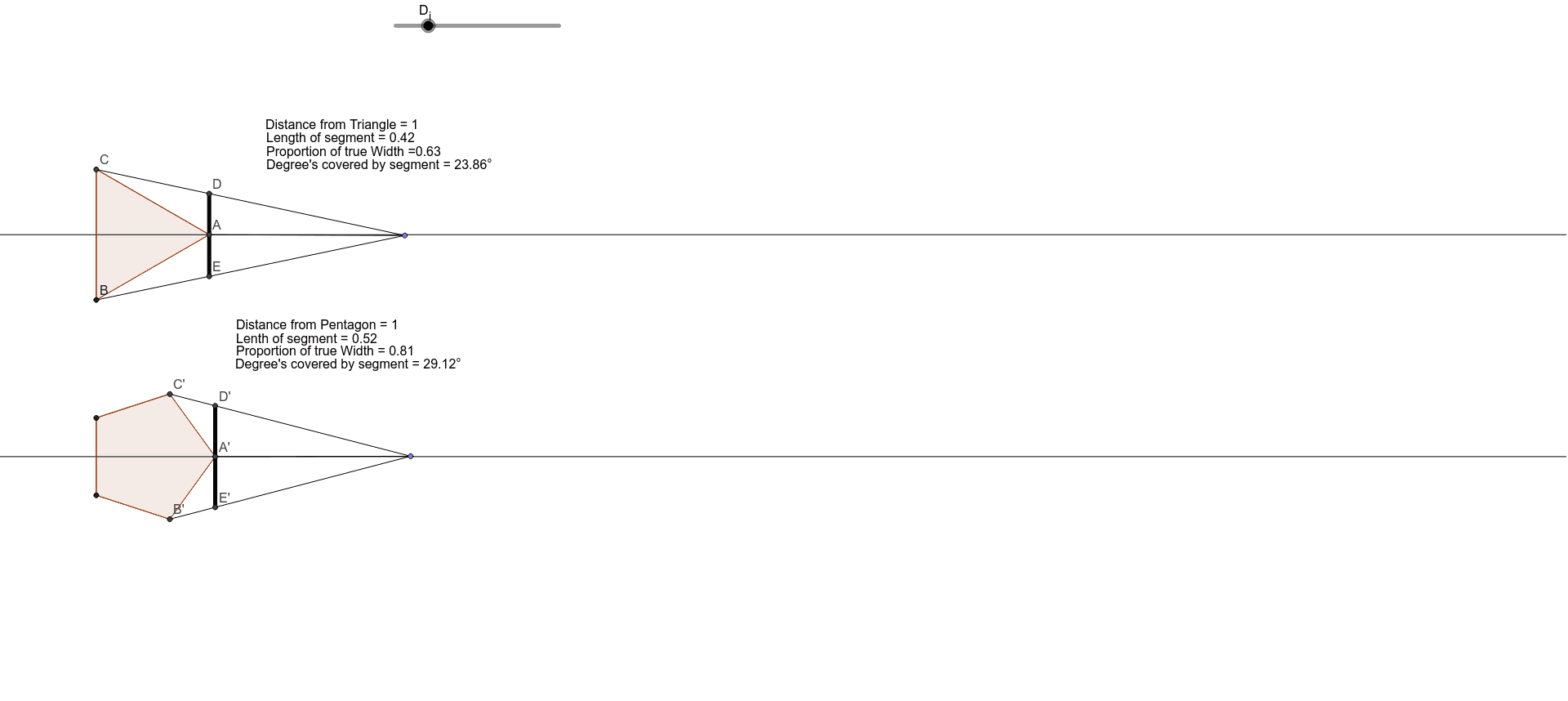
This example demonstrates the geometric properties and distributions of polygons in a flatland view. Core math concepts include polygon construction, function graphing, inequality representation, trigonometric function application, and prism geometry. Construction highlights from the summary involve commands like Point, Polygon, Segment, Line, LineBisector, OrthogonalLine, and Intersect, along with objects such as D_i, J, E, etc. Suitable for high school and above students to understand polygon geometry, function-geometry integration, and introductory solid geometry.
GeoGebra Commands & Parameters
Point(yAxis) → EPoint(yAxis) → DPolygon(D, E, 5) → poly2, P_S, e, f, g, h, F, G, HSegment(H, F) → kLine(J, F) → pLine(J, H) → nLineBisector(P_S) → jOrthogonalLine(G, j) → rIntersect(p, r) → NIntersect(n, r) → MSegment(M, N) → L_PPoint(yAxis) → BPoint(yAxis) → APolygon(A, B, 3) → poly1, T_S, b, c, CLineBisector(T_S) → iLine(A, I) → lLine(B, I) → mOrthogonalLine(C, i) → qIntersect(l, q) → KIntersect(m, q) → LSegment(C, I) → D_TSegment(G, J) → D_PSegment(K, L) → L_TSegment(O, P) → aSegment(Q, R) → dSegment(A, I) → sSegment(I, B) → tSegment(H, J) → a_1Segment(J, F) → b_1
AI Drawing Prompt Reference
Draw a flatland view of polygons, including a pentagon and a triangle connected by segments and angles. Start by placing two points on the y-axis, then construct a pentagon and a triangle using these points as vertices. Next, find the perpendicular bisectors of the pentagon and triangle, and locate their intersection points. Finally, connect these points and vertices to form the edges and internal structure of the polygons, highlighting their geometric properties and distribution.
The prompt above was compiled from the original drawing commands and is for reference only.