
Exploring Translations: Triangle and Its Image by Chase Coffey
Loading the math board and drawing, please wait…
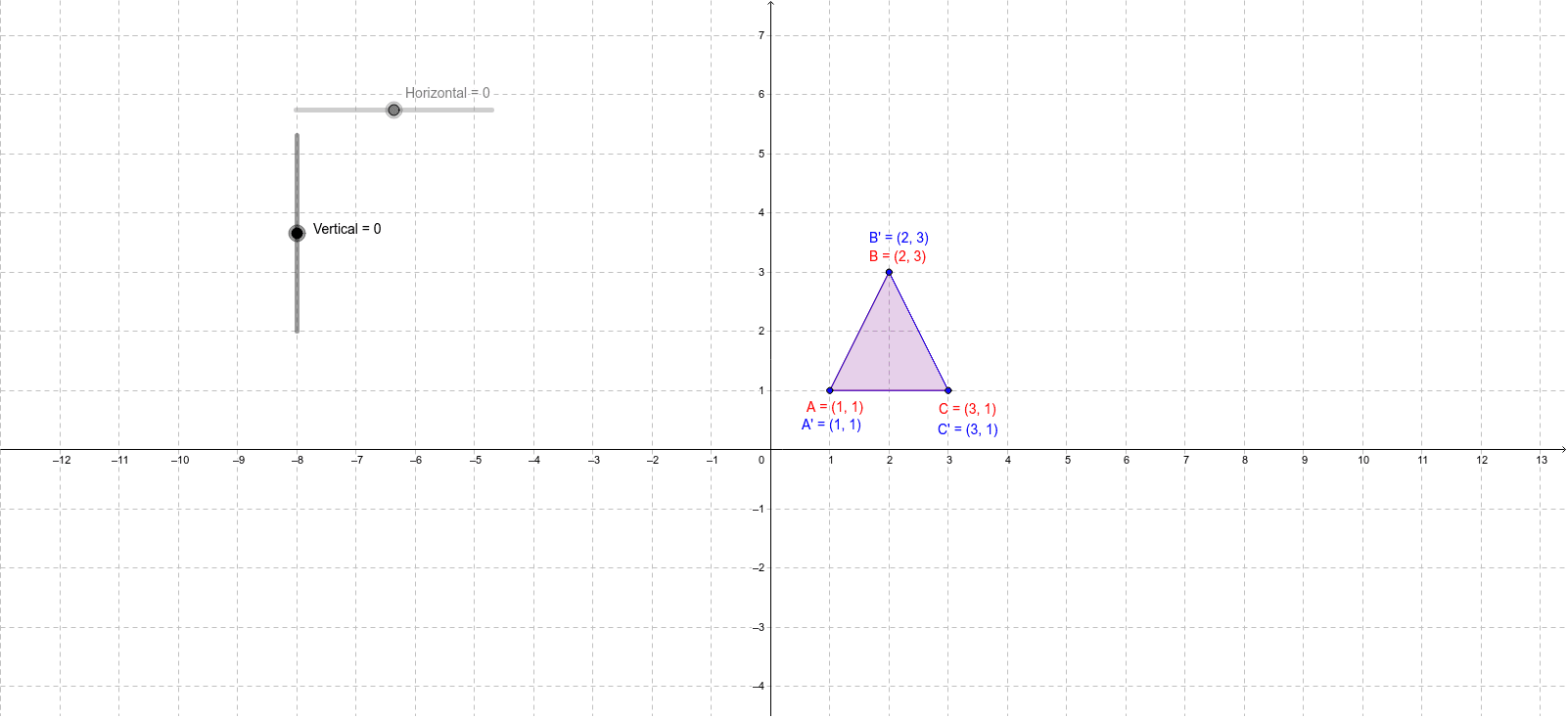
① This example demonstrates the geometric transformation of translation by showing a triangle and its translated image. ② Core mathematical concepts include translation, congruence, vectors, and complex numbers, with extensions to prisms and function graphs. ③ Construction details: Using GeoGebra commands, a polygon (poly1) is created from vertices A, B, C, and horizontal/vertical components define the translation vector, producing image points A', B', C' and polygon poly2. The sides c, a_1, b_1 and their images c', a', b' are also constructed to highlight corresponding segments. ④ Suitable for middle/high school geometry, introductory linear algebra, or math lab sessions, helping students grasp coordinate representation of translations, congruence properties, and dynamic geometry software operations.
GeoGebra Commands & Parameters
Polygon(A, B, C) → poly1, c, a_1, b_1Polygon(A', B', C') → poly2, c', a', b'
AI Drawing Prompt Reference
Draw a triangle and its translated image. Start with the original triangle, then apply a translation defined by horizontal and vertical components to each vertex, obtaining three new vertices. Connect these new vertices to form a second triangle. Use dashed lines or distinct colors to highlight corresponding sides between the two triangles, emphasizing their congruence. Optionally, draw arrows or segments from each original vertex to its translated counterpart to indicate the translation vector. The overall figure should clearly illustrate the geometric effect of translation.
The prompt above was compiled from the original drawing commands and is for reference only.