
Exploring the Geometric Properties of a Rhombus
This interactive GeoGebra applet is designed to help middle school students thoroughly explore and understand the fundamental geometric properties of a rhombus. Serving as a dynamic digital manipulative, the tool bridges the gap between abstract geometric definitions and concrete visual evidence, making it an invaluable resource for plane geometry instruction.
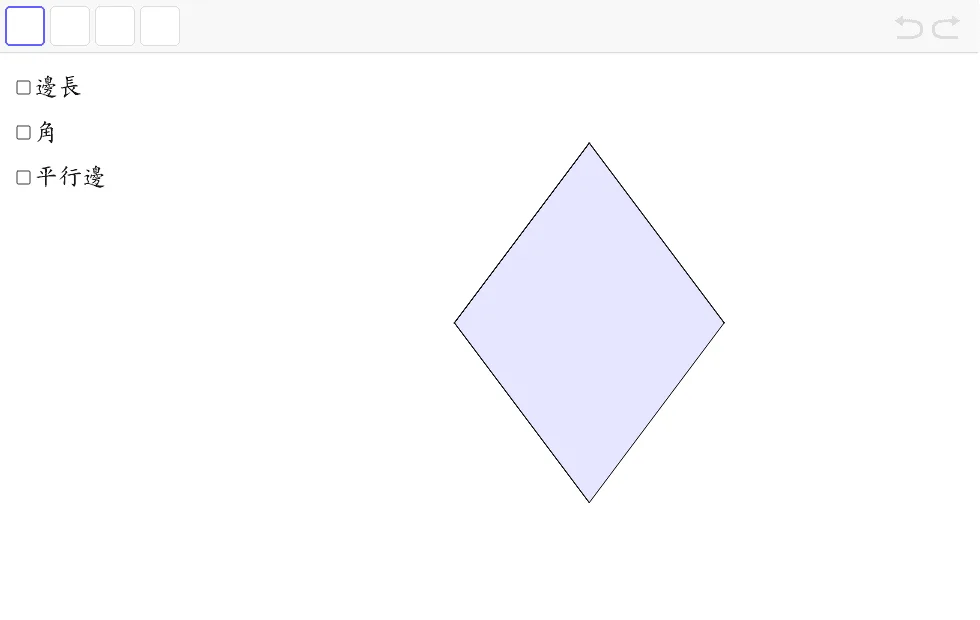
The applet meticulously demonstrates the defining characteristics of a rhombus, which is a special type of parallelogram. Through clear visual indicators and real-time measurements, students can observe that all four sides of the shape are strictly equal in length. Furthermore, the applet highlights that opposite interior angles are congruent and that the two diagonals act as perpendicular bisectors of each other. Users can also observe how the diagonals bisect the vertex angles, reinforcing the deep symmetry inherent in the shape.
To build a robust and mathematically accurate model, the applet utilizes specific GeoGebra features, including the Polygon and Vector commands. What makes this tool particularly engaging is its simulation of traditional physical construction methods. It mimics classic straightedge and compass techniques alongside digital paper-folding operations. These folding simulations are especially effective for demonstrating line symmetry, reflections, and the congruent triangles formed by the intersecting diagonals.
Interactivity is at the core of the learning experience. Students and teachers can click and drag the vertices of the rhombus to dynamically reshape it. As the dimensions and angles change, the geometric relationships, side lengths, and angle measures update instantaneously. This dynamic manipulation allows learners to empirically verify that the core properties of a rhombus remain invariant, regardless of the shape's size, proportions, or orientation on the plane.
The educational benefits of this applet are substantial. By transitioning away from static textbook diagrams, students are encouraged to actively investigate geometric theorems rather than passively memorizing them. This hands-on exploration fosters critical spatial reasoning, logical deduction, and a profound intuitive grasp of two-dimensional geometry. It is perfectly suited for middle school mathematics classrooms, providing teachers with a powerful demonstration tool and offering students an engaging environment for self-guided discovery and conceptual mastery.
Loading the math board and drawing, please wait…