
Dynamic Illustration of Equidistant Chords in a Circle
Loading the math board and drawing, please wait…
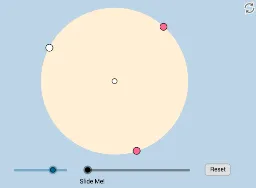
This example dynamically illustrates the theorem that in a circle, if two chords are equidistant from the center, they are congruent. It involves core concepts like circle, chords, distance from center, and congruent triangles. Construction highlights include commands like Circle, Point, Segment, Intersect, OrthogonalLine, Dilate, Min, CircleSector, Rotate, Angle, Line, Vector, and Translate. Suitable for high school geometry education to visually understand circle properties and proof methods.
GeoGebra Commands & Parameters
Circle(A, B) → cPoint(c) → CPoint(c) → DSegment(A, C) → aSegment(A, D) → bIntersect(e, a, 1) → EIntersect(e, b, 1) → FOrthogonalLine(E, a) → fOrthogonalLine(F, b) → gIntersect(c, f, 2) → GIntersect(c, f, 1) → HIntersect(c, g, 1) → IIntersect(c, g, 2) → JSegment(G, H) → jSegment(I, J) → kDilate(A, If[0 < h ≤ 1, 1 - h, 0], E) → A'Dilate(A, If[0 < h ≤ 1, 1 - h, 0], F) → A'_1Segment(A, A') → iSegment(A, A'_1) → lMin(d, m) → nCircle(E, (0.25 * n)) → pCircle(F, (0.25 * n)) → qSegment(A, E) → rSegment(A, F) → sIntersect(p, r) → K,Intersect(q, s) → L,Intersect(q, k) → M, NIntersect(p, j) → O, PCircleSector(F, N, L) → c_1CircleSector(E, K, P) → tRotate(t, If[1.5 < h ≤ 2.5, ((-(h - 1.5)) * π / 2), ((-π)) / 2], E) → t'Rotate(c_1, If[2.5 < h ≤ 3.5, ((h - 2.5) * π / 2), π / 2], F) → d_1Angle(F, A, E) → αRotate(A, If[3.5 < h ≤ 4.5, ((-(h - 3.5)) * α), (-α)], A) → A'_2Rotate(A', If[3.5 < h ≤ 4.5, ((-(h - 3.5)) * α), (-α)], A) → A''Segment(A'_2, A'') → i'Dilate(H, If[0 < h ≤ 1, 1 - h, 0], G) → H'Segment(H, H') → f_1Dilate(I, If[0 < h ≤ 1, 1 - h, 0], J) → I'Segment(I, I') → g_1Line(J, f_1) → h_1Point(h_1) → QAngle(Q, J, I) → βDilate(H, If[5 < h ≤ 6, 6 - h, 0], J) → H'_1Vector(H, H'_1) → uTranslate(H, u) → H'_2Translate(H', u) → H''Segment(H'_2, H'') → i_1Rotate(H'_2, If[6 < h ≤ 7, ((h - 6) * β), β], J) → RRotate(H'', If[6 < h ≤ 7, ((h - 6) * β), β], J) → H'''Segment(R, H''') → j_1
AI Drawing Prompt Reference
Draw a circle with center A and any radius. Select two points C and D on the circle and draw segments AC and AD. Construct two lines perpendicular to AC and AD, intersecting the circle at points E and F. With E and F as centers, draw two circles with radii one-fourth of EF. Construct the angle EAF and rotate segments AC and AD around A by the angle EAF. Construct points G and H such that GH is perpendicular to AC, and points I and J such that IJ is perpendicular to AD. Draw segments GH and IJ, which are of equal length. With G as the center, draw a circle p with radius one-fourth of GH; with I as the center, draw a circle q with radius one-fourth of IJ. Find the intersection points K and L of circles p and q, and the intersection points M and N of segments GH and IJ. Rotate segments GH and IJ to form arcs c1 and t with centers F and E, respectively, and radii one-fourth of MN. Rotate segments GH and IJ around A by the angles FAN and EAK. Construct points H' and I' symmetric to H and I with respect to G and J, and draw segments H'G and I'J. Draw lines H'G and I'J, which intersect segments GH and IJ at points Q and R. Rotate segments GH and IJ around J by the angles QIJ and H'GJ.
The prompt above was compiled from the original drawing commands and is for reference only.