
Dynamic Cross-Section Polygon of a Plane Intersecting a Cube
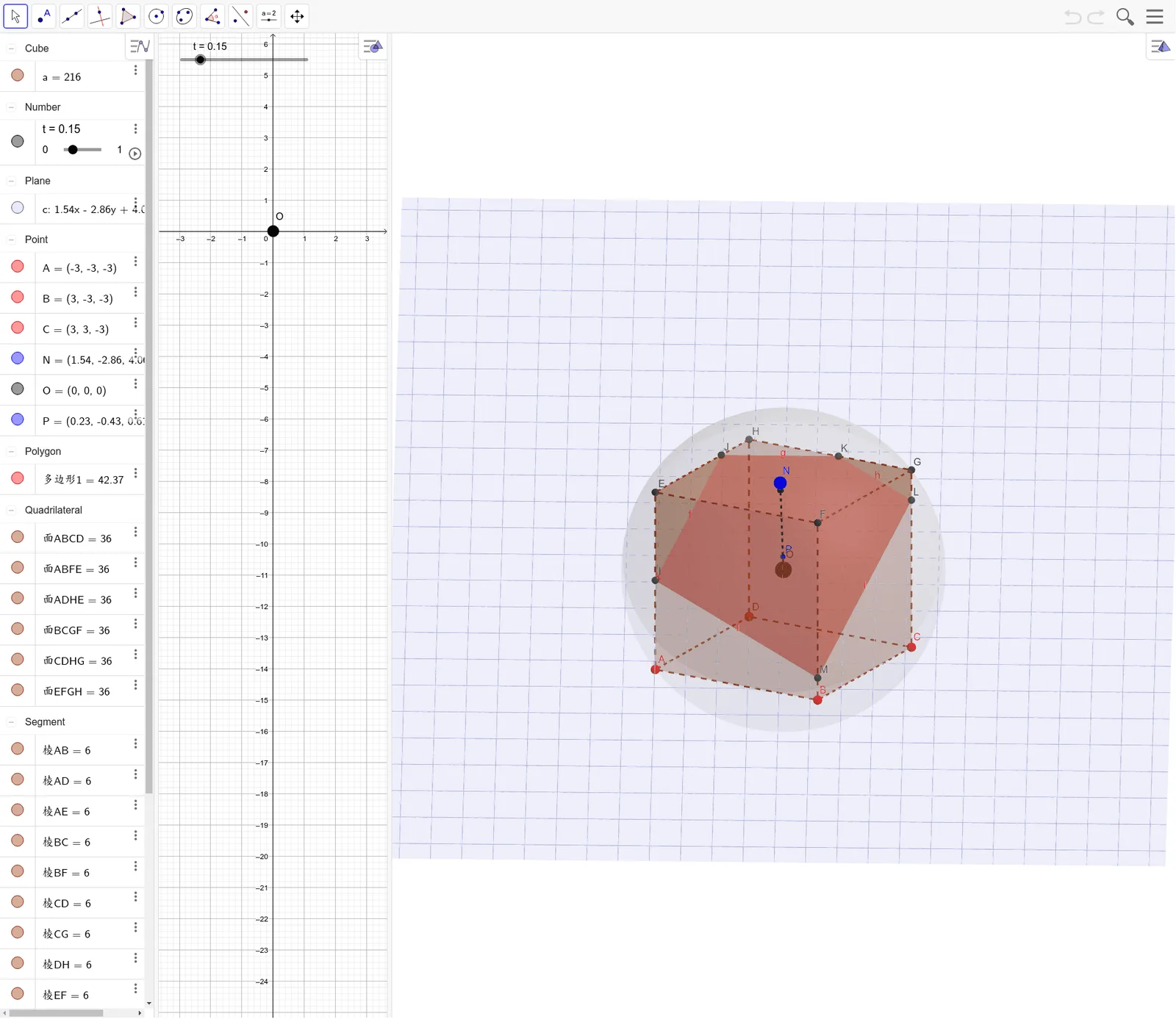
This GeoGebra applet provides a comprehensive and interactive demonstration of the geometric construction of a cross-section formed when a plane intersects a cube. Designed for high school and introductory college geometry students, the tool visually breaks down the complex spatial relationship between a two-dimensional plane and a three-dimensional polyhedron. The underlying mathematical model rigorously defines the cube using its fundamental components: eight vertices, twelve edges, and six faces. By leveraging advanced GeoGebra commands such as OrthogonalPlane and IntersectPath, the applet dynamically calculates and generates the exact intersection polygon in real time, labeling the resulting vertices as I, J, K, L, M, and so on.
The core interactive feature allows users to manipulate the intersecting plane by adjusting its parameters, such as its position, orientation, and angle relative to the cube. As students drag control points or use sliders to translate and rotate the plane, they can instantly observe how the cross-sectional shape morphs. This hands-on exploration enables users to visually discover and verify the different types of polygons that can be formed by slicing a cube. Depending on the plane configuration, the cross-section can dynamically transform into a triangle, various quadrilaterals including squares, rectangles, parallelograms, and trapezoids, a pentagon, or a regular or irregular hexagon.
From a pedagogical perspective, this applet is an invaluable resource for developing spatial reasoning and deepening the understanding of solid geometry. It helps students overcome the common cognitive hurdle of visualizing three-dimensional intersections on a two-dimensional screen. By experimenting with the plane orientation, learners can deduce fundamental geometric rules, such as why a cube can never yield a cross-section with more than six sides, since the plane can intersect a maximum of six faces, or why certain regular polygons can or cannot be formed. Teachers can use this dynamic visualization to guide inquiry-based learning, prompting students to predict the shape of the cross-section before adjusting the plane, and then verifying their hypotheses. Ultimately, this interactive model transforms abstract theoretical concepts into tangible, observable phenomena, making the study of polyhedral cross-sections both intuitive and engaging.
Loading the math board and drawing, please wait…