
Discover Pythagoras Theorem
Loading the math board and drawing, please wait…
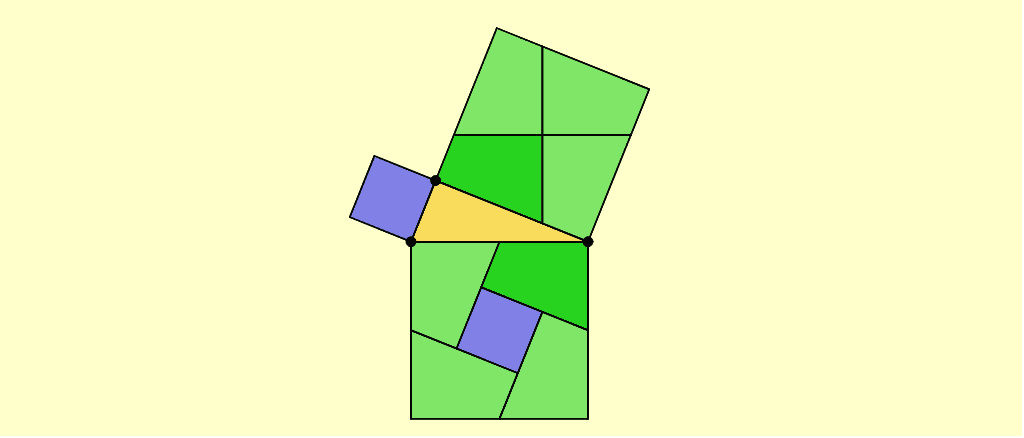
This example demonstrates the Pythagorean theorem by moving a point, illustrating the relationship between the sides of a right triangle. Core concepts include Pythagoras theorem, right triangles, and coordinate geometry. Constructed using commands like Point, Semicircle, Midpoint, OrthogonalLine, Intersect, Circle, CircleArc, Polygon, Segment in GeoGebra. Suitable for middle school students and above to learn and understand the proof and application of the Pythagorean theorem.
GeoGebra Commands & Parameters
Point(xAxis) → APoint(xAxis) → BSemicircle(A, B) → cMidpoint(A, B) → COrthogonalLine(C, xAxis) → aIntersect(c, a) → D,Circle(D, 0.1) → dIntersect(d, c) → E, F, ,CircleArc(C, F, A) → ePoint(e) → GPolygon(A, B, G) → mnohoúhelník1, g, a_1, bPolygon(G, B, 4) → mnohoúhelník2, f, h, i, j, H, IPolygon(A, G, 4) → mnohoúhelník3, k, l, m, n, J, KPolygon(B, A, 4) → mnohoúhelník4, p, q, r, s, L, MSegment(G, H) → tSegment(B, I) → b_1Intersect(t, b_1) → NOrthogonalLine(N, g) → c_1OrthogonalLine(N, c_1) → d_1Intersect(d_1, j) → OIntersect(d_1, h) → PIntersect(f, c_1) → QIntersect(c_1, i) → RSegment(Q, B) → e_1Segment(B, H) → f_1Segment(H, I) → g_1Segment(I, G) → h_1Segment(G, Q) → i_1Segment(Q, N) → j_1Segment(N, P) → k_1Segment(N, R) → l_1Segment(N, O) → m_1Circle(L, Segment[N, P]) → p_1Circle(M, Segment[N, Q]) → q_1Circle(B, Segment[N, Q]) → r_1Circle(A, Segment[N, Q]) → s_1Intersect(p_1, r) → S,Intersect(q_1, s) → T,Intersect(r_1, g) → U,Intersect(s_1, q) → V,Circle(Q, Segment[B, Q]) → t_1Circle(S, Segment[Q, B]) → c_2Circle(T, Segment[Q, B]) → d_2Circle(U, Segment[B, Q]) → e_2Circle(V, Segment[Q, B]) → f_2Intersect(t_1, j_1) → W,Intersect(c_2, r) → Z, A_1Intersect(d_2, s) → B_1, C_1Intersect(g, p) → D_1Intersect(e_2, g) → E_1, F_1Intersect(e_2, f_2) → G_1, N_1, ,Intersect(f_2, q) → H_1, I_1Circle(Z, Segment[B, W]) → g_2Circle(B_1, Segment[B, W]) → h_2Circle(F_1, Segment[B, W]) → k_2Circle(H_1, Segment[B, W]) → p_2Intersect(c_2, g_2, 2) → J_1Intersect(d_2, h_2, 2) → K_1Intersect(e_2, k_2, 2) → L_1Intersect(f_2, p_2, 2) → M_1Segment(L, S) → n_1Segment(S, J_1) → a_2Segment(J_1, V) → b_2Segment(V, L) → i_2Segment(S, M) → j_2Segment(M, B) → l_2Segment(B, A) → m_2Segment(A, L) → n_2Segment(S, K_1) → q_2Segment(T, L_1) → r_2Segment(U, M_1) → s_2Polygon(L, S, J_1, V) → mnohoúhelník5, l_3, s_3, j_3, vPolygon(S, M, T, K_1) → mnohoúhelník6, s_4, m_3, t_2, k_3Polygon(T, B, U, L_1) → mnohoúhelník7, t_3, b_3, u, l_4Polygon(U, A, V, M_1) → mnohoúhelník8, u_1, a_3, v_1, m_4Polygon(Q, B, P, N) → mnohoúhelník9, q_3, b_4, p_3, n_3Polygon(Q, G, O, N) → mnohoúhelník10, q_4, g_3, o, n_4Polygon(N, P, H, R) → mnohoúhelník11, n_5, p_4, h_3, r_3Polygon(N, O, I, R) → mnohoúhelník12, n_6, o_1, i_3, r_4Polygon(M_1, J_1, K_1, L_1) → mnohoúhelník13, m_5, j_4, k_4, l_5Polygon(A, B, G) → mnohoúhelník14, g_4, a_4, b_5Segment(A, K) → c_3Segment(K, J) → d_3Segment(J, G) → e_3Segment(G, A) → f_3Segment(L, M) → c_4
AI Drawing Prompt Reference
Draw a coordinate plane with a horizontal segment as the base of a right triangle. Construct a semicircle with this segment as its diameter, and pick a point on the semicircle to form the right triangle by connecting it to the segment's endpoints. Then, construct squares outward on each of the three sides of the triangle. Add auxiliary lines and intersection points inside the figure to create smaller triangles and quadrilaterals that illustrate the geometric proof of the Pythagorean theorem. Finally, place several circles at key positions for marking or explanatory purposes. The overall figure should clearly show the area relationships among the squares on the three sides.
The prompt above was compiled from the original drawing commands and is for reference only.