
Dice Average
Loading the math board and drawing, please wait…
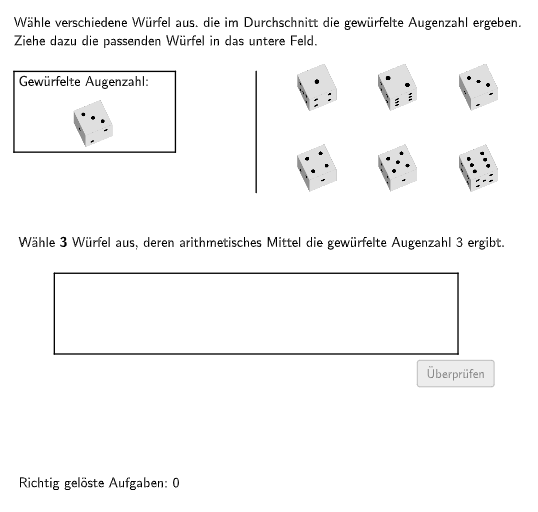
This example demonstrates calculating the average of dice rolls. Key mathematical concepts include arithmetic mean, median, and mode. GeoGebra commands such as Shuffle and Sum are used for data processing and graphical representation. Suitable for 5th to 6th grade students to practice probability and statistics.
GeoGebra Commands & Parameters
Shuffle(Sequence[Random[2, 5], i, 1, 100]) → gewAugenzahl, {3, 5, 3, 5, 3, 3, 4, 5, 5, 5, 4, 4, 5, 4, 2, 4, 4, 5, 5, 4, 5, 5, 5, 4, 5, 3, 3, 5, 3, 2, 5, 4, 3, 2, 3, 3, 4, 4, 5, 5, 5, 2, 2, 2, 5, 5, 2, 3, 5, 4, 2, 2, 4, 5, 2, 5, 4, 5, 4, 3, 4, 2, 2, 4, 3, 3, 4, 3, 5, 3, 3, 3, 4, 5, 3, 4, 4, 5, 4, 5, 5, 4, 2, 3, 3, 2, 4, 4, 3, 5, 5, 5, 3, 4, 3, 3, 2, 5, 5, 3}Append(true, Sequence[If[gewAugenzahl(i) ≟ gewAugenzahl(i - 1), false, true], i, 2, 100]) → stayXRemove(Sequence[If[stayX(i), gewAugenzahl(i), 0], i, 1, 100], Sequence[0, i, 1, 100]) → randomNosForXwithoutRepeatMidpoint(Corner[B63, 1], Corner[B63, 3]) → MidPoint_{B63}Midpoint(Corner[B62, 1], Corner[B62, 3]) → MidPoint_{B62}Midpoint(Corner[B53, 1], Corner[B53, 3]) → MidPoint_{B53}Midpoint(Corner[B52, 1], Corner[B52, 3]) → MidPoint_{B52}Midpoint(Corner[B43, 1], Corner[B43, 3]) → MidPoint_{B43}Midpoint(Corner[B42, 1], Corner[B42, 3]) → MidPoint_{B42}Midpoint(Corner[B33, 1], Corner[B33, 3]) → MidPoint_{B33}Midpoint(Corner[B32, 1], Corner[B32, 3]) → MidPoint_{B32}Midpoint(Corner[B23, 1], Corner[B23, 3]) → MidPoint_{B23}Midpoint(Corner[B22, 1], Corner[B22, 3]) → MidPoint_{B22}Midpoint(Corner[B13, 1], Corner[B13, 3]) → MidPoint_{B13}Midpoint(Corner[B12, 1], Corner[B12, 3]) → MidPoint_{B12}Polygon(M, N, O, P) → v1, m, n, o, pIsInRegion(MidPoint_{B63}, v1) → in6_3IsInRegion(MidPoint_{B62}, v1) → in6_2IsInRegion(MidPoint_{B53}, v1) → in5_3IsInRegion(MidPoint_{B52}, v1) → in5_2IsInRegion(MidPoint_{B43}, v1) → in4_3IsInRegion(MidPoint_{B42}, v1) → in4_2IsInRegion(MidPoint_{B33}, v1) → in3_3IsInRegion(MidPoint_{B32}, v1) → in3_2IsInRegion(MidPoint_{B23}, v1) → in2_3IsInRegion(MidPoint_{B22}, v1) → in2_2IsInRegion(MidPoint_{B13}, v1) → in1_3IsInRegion(MidPoint_{B12}, v1) → in1_2Midpoint(Corner[Bild6, 1], Corner[Bild6, 3]) → MidPoint_{Bild6}IsInRegion(MidPoint_{Bild6}, v1) → in6Midpoint(Corner[Bild5, 1], Corner[Bild5, 3]) → MidPoint_{Bild5}IsInRegion(MidPoint_{Bild5}, v1) → in5Midpoint(Corner[Bild4, 1], Corner[Bild4, 3]) → MidPoint_{Bild4}IsInRegion(MidPoint_{Bild4}, v1) → in4Midpoint(Corner[Bild3, 1], Corner[Bild3, 3]) → MidPoint_{Bild3}IsInRegion(MidPoint_{Bild3}, v1) → in3Midpoint(Corner[Bild2, 1], Corner[Bild2, 3]) → MidPoint_{Bild2}IsInRegion(MidPoint_{Bild2}, v1) → in2Midpoint(Corner[Bild1, 1], Corner[Bild1, 3]) → MidPoint_{Bild1}IsInRegion(MidPoint_{Bild1}, v1) → in1Shuffle(Sequence[Random[3, 6], i, 1, 100]) → anzahlWürfelZiehbar, {3, 4, 3, 3, 4, 4, 4, 5, 3, 5, 4, 4, 3, 3, 4, 4, 6, 6, 5, 3, 5, 6, 5, 4, 4, 5, 5, 5, 6, 4, 6, 6, 3, 4, 4, 6, 6, 5, 3, 6, 3, 6, 4, 3, 5, 6, 3, 5, 4, 4, 3, 5, 5, 3, 5, 3, 4, 6, 4, 4, 4, 4, 5, 4, 3, 5, 3, 5, 4, 6, 4, 6, 6, 5, 3, 4, 6, 3, 3, 5, 6, 4, 4, 4, 4, 6, 3, 6, 3, 5, 3, 4, 5, 3, 6, 3, 4, 4, 6, 6}Element(anzahlWürfelZiehbar, Mod[questionCount, 100] + 1) → würfelZahlElement(randomNosForXwithoutRepeat, Mod[questionCount, 100] + 1) → augenZahlIf(in1, 1, 0) → zahl1If(in2, 2, 0) → zahl2If(in3, 3, 0) → zahl3If(in4, 4, 0) → zahl4If(in5, 5, 0) → zahl5Sum(listeElementeInVieleck) → sumCorrectIf(in6, 6, 0) → zahl6If(in1_2, 1, 0) → zahl1_2If(in1_3, 1, 0) → zahl1_3If(in2_2, 2, 0) → zahl2_2If(in2_3, 2, 0) → zahl2_3If(in3_2, 3, 0) → zahl3_2If(in3_3, 3, 0) → zahl3_3If(in4_2, 4, 0) → zahl4_2If(in4_3, 4, 0) → zahl4_3If(in5_2, 5, 0) → zahl5_2If(in5_3, 5, 0) → zahl5_3If(in6_2, 6, 0) → zahl6_2If(in6_3, 6, 0) → zahl6_3Sum(listeSumme) → augenSummeTextfield(aInput) → InputBox1Textfield(bInput) → InputBox2Polygon(PtopLeftCornerFeedback, PtopRightCornerFeedback, PbottomRightCornerFeedback, PbottomLeftCornerFeedback) → rectangleCorrect, ptopleftcornerfeedback, ptoprightcornerfeedback, pbottomrightcornerfeedback, pbottomleftcornerfeedbackAppend(true, Sequence[If[anzahlWürfelZiehbar(i) ≟ anzahlWürfelZiehbar(i - 1), false, true], i, 2, 100]) → stayYRemove(Sequence[If[stayY(i), anzahlWürfelZiehbar(i), 0], i, 1, 100], Sequence[0, i, 1, 100]) → randomNosForYwithoutRepeatElement(randomNosForXwithoutRepeat, Mod[questionCount, Length[randomNosForXwithoutRepeat]] + 1) → numXwithoutRepeatElement(randomNosForYwithoutRepeat, Mod[questionCount, Length[randomNosForYwithoutRepeat]] + 1) → numYwithoutRepeatDefined((aInput * bInput)) → fixedPolygon(Q, R, S, T) → v2, q, r, s, tSegment(U, V) → gMidpoint(Corner[Zweier, 1], Corner[Zweier, 3]) → MidPoint_{Bild8}Midpoint(Corner[Dreier, 1], Corner[Dreier, 3]) → MidPoint_{Bild9}Midpoint(Corner[Vierer, 1], Corner[Vierer, 3]) → MidPoint_{Bild10}Midpoint(Corner[Fünfer, 1], Corner[Fünfer, 3]) → MidPoint_{Bild11}If(in1, Append[zahl1, {}]) → anfügenArithm1If(in2, Append[zahl2, anfügenArithm1]) → anfügenArithm2If(in3, Append[zahl3, anfügenArithm2]) → anfügenArithm3If(in4, Append[zahl4, anfügenArithm3]) → anfügenArithm4If(in5, Append[zahl5, anfügenArithm4]) → anfügenArithm5If(in6, Append[zahl6, anfügenArithm5]) → anfügenArithm6Midpoint(Corner[Zweier, 1], Corner[Zweier, 3]) → MidPoint_{Zweier}Midpoint(Corner[Dreier, 1], Corner[Dreier, 3]) → MidPoint_{Dreier}Midpoint(Corner[Vierer, 1], Corner[Vierer, 3]) → MidPoint_{Vierer}Midpoint(Corner[Fünfer, 1], Corner[Fünfer, 3]) → MidPoint_{Fünfer}CountIf(x > 0, listeElementeInVieleck) → zähleWennTestSum(gezogen) → sumIn
AI Drawing Prompt Reference
Create a visualization showing the average of dice rolls, including a sequence of 100 random dice numbers and a sequence with unique values obtained by removing duplicates. Connect the unique values to form a polygon. Then, represent the frequency of each number with different colored regions, highlighting the probability distribution.
The prompt above was compiled from the original drawing commands and is for reference only.