
Demonstrating the Area of a Rhombus Formula
Loading the math board and drawing, please wait…
In collections
Area Investigations
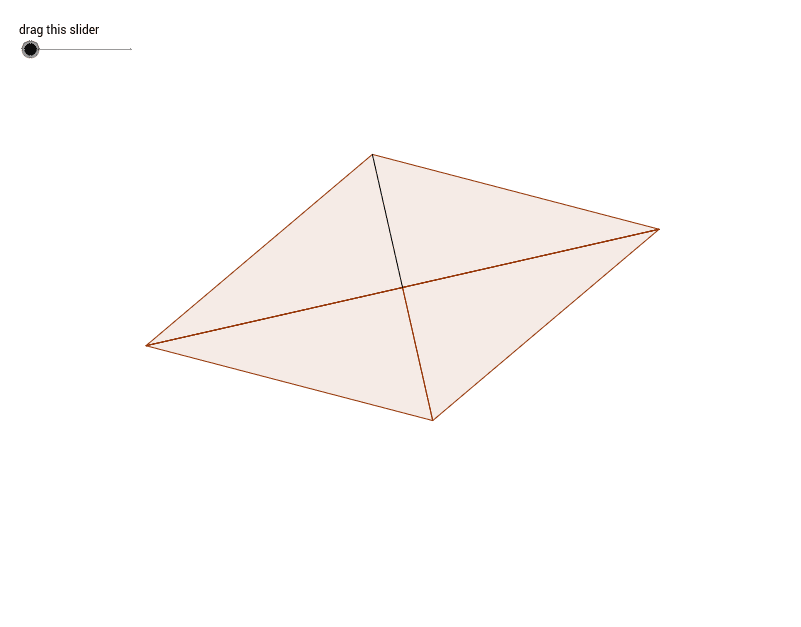
This example illustrates one geometric proof for the area formula of a rhombus, A=1/2d1d2. It involves core concepts like rhombus, parallelogram, circumcircle, angle bisectors, and vectors. The construction uses GeoGebra commands such as Segment, LineBisector, Intersect, Point, Circle, Polygon, Vector, Translate, Line, OrthogonalLine, Mirror. Suitable for high school students learning geometric proofs and properties of rhombuses.
GeoGebra Commands & Parameters
Segment(A, B) → aLineBisector(a) → bIntersect(b, a) → CPoint(b) → DCircle(C, D) → cIntersect(c, b, 2) → EPolygon(A, C, E) → poly2, e_1, a_2, c_1Polygon(C, B, E) → poly3, e_2, c_2, b_2Polygon(D, A, B) → poly1, b_1, d, a_1Vector(A, (r * x(D), r * y(D))) → uTranslate(A, u) → A'Translate(C, u) → C'_1Translate(E, u) → E'_1Polygon(A', C'_1, E'_1) → poly2', e', a', c'Line(D, B) → eTranslate(B, u) → B'_1Vector(B, B'_1) → vOrthogonalLine(B, d) → fMirror(B'_1, f) → B''Vector(B, B'') → wTranslate(C, w) → C'Translate(B, w) → B'Translate(E, w) → E'Polygon(C', B', E') → poly3', e'_1, c'_1, b'Segment(D, C) → gOrthogonalLine(F, b') → hCircle(F, 0.1 * b') → kIntersect(k, h) → G, HLine(H, b') → iCircle(H, 0.5 * b') → pIntersect(p, i) → I, JVector(H, J) → zVector(H, I) → jCircle(D, 0.1 * b') → qIntersect(q, b) → K, LLine(L, e') → lCircle(L, e') → sIntersect(s, l) → M, NVector(L, M) → mVector(L, N) → n
AI Drawing Prompt Reference
Draw a rhombus and illustrate a geometric proof for its area formula A=1/2d1d2. Start by constructing one side and the angle bisector of the rhombus, finding their intersection point, and drawing a circle centered at this point. The circle intersects the angle bisector at another point, forming two small triangles. Create vectors from the angle bisector and translate the rhombus and triangles accordingly, forming new shapes. Then, use reflections and rotations to generate additional triangles and parallelograms. Finally, add guide lines, circles, and intersection points to visualize the entire proof process.
The prompt above was compiled from the original drawing commands and is for reference only.