
Demonstrating the Area of a Parallelogram Formula
Loading the math board and drawing, please wait…
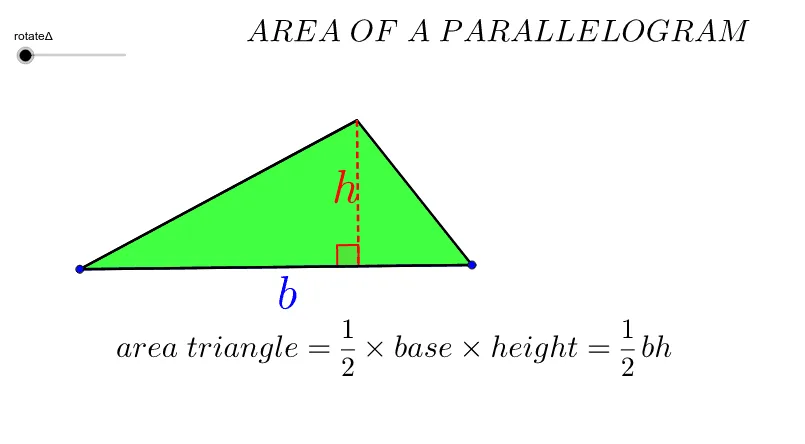
This example shows how to derive the area formula of a parallelogram by constructing it and dividing into triangles. Key math concepts include parallelogram, triangle area, cosine theorem, and vectors. GeoGebra commands and objects used are Segment, Line, Point, Polygon, Midpoint, Rotate, OrthogonalLine, Intersect, If, Angle. Suitable for middle school students and above to understand the geometric meaning and derivation of the formula.
GeoGebra Commands & Parameters
Segment(A, B) → a_2Line(C, a_2) → b_2Point(b_2) → DPolygon(A, D, B) → P, a, b, dMidpoint(D, B) → ERotate(A, -rotateΔ, E) → A'Rotate(C, -rotateΔ, E) → C'Rotate(D, -rotateΔ, E) → D'Rotate(B, -rotateΔ, E) → B'Polygon(A', D', B') → P', g, i, jLine(A, B) → eOrthogonalLine(D, e) → fIntersect(f, e) → FMidpoint(B', A') → GMidpoint(D', C') → HIf(rotateΔ ≥ 0°, H) → IIf(rotateΔ > 0°, H) → JIf(rotateΔ > 0°, G) → KSegment(D, F) → hAngle(D, F, A) → βMidpoint(h) → LMidpoint(a_2) → M