
Cylindrical Coordinates: 3D Points and Geometric Transformations
Loading the math board and drawing, please wait…
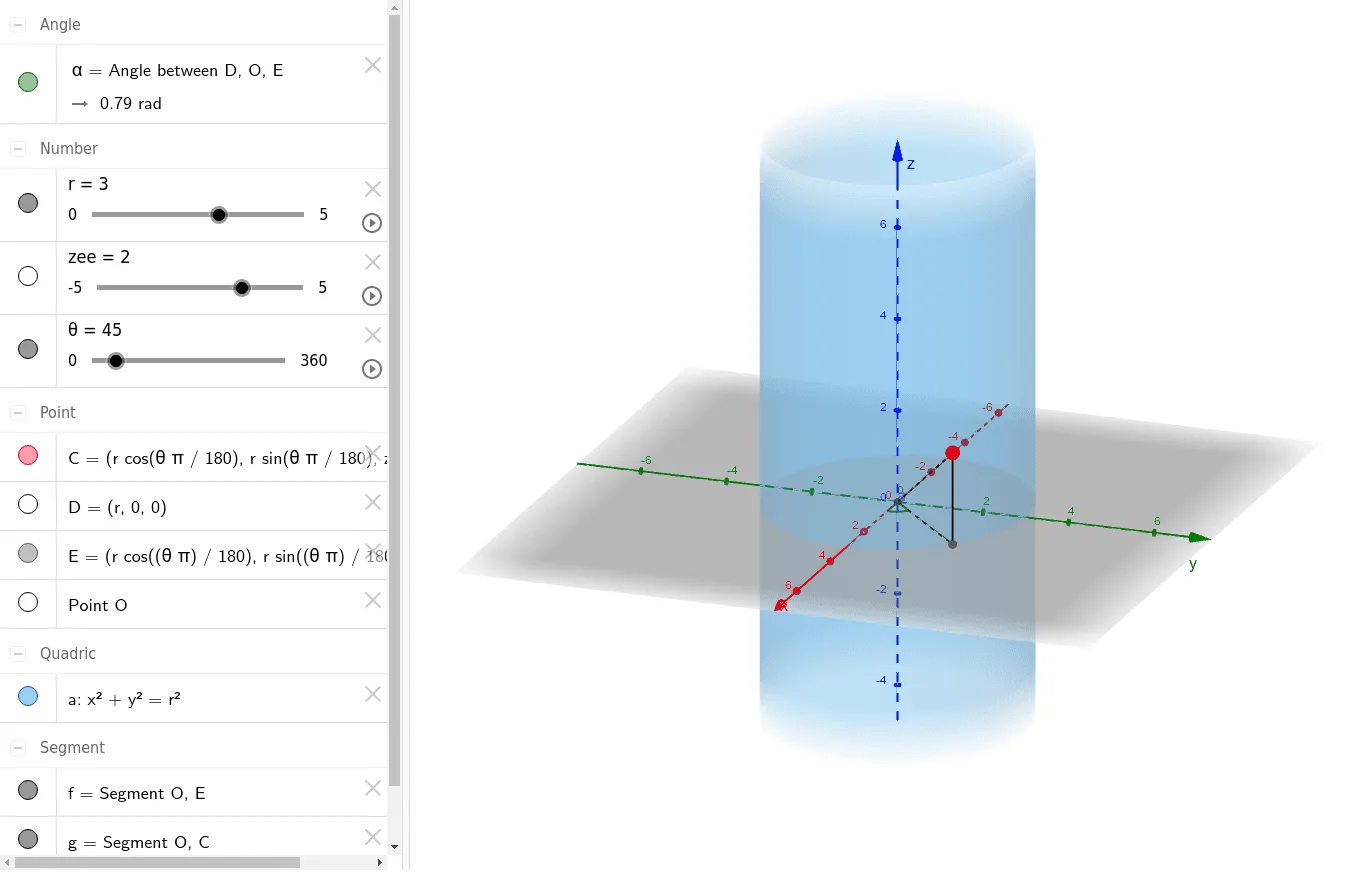
①This GeoGebra example dynamically illustrates the position of points in cylindrical coordinates (r, θ, z) and their geometric transformations in 3D space, clearly showing the relationship between cylindrical and Cartesian coordinates. ②Core mathematical concepts include the definition of cylindrical coordinate systems, polar representation of radius r and angle θ, and the application of linear functions and geometric transformations (such as reflection and multiplication/scaling) in three dimensions. ③Construction highlights: using the Segment command to draw coordinate axes or radial distances, the Angle command to mark angle θ, and objects like zee, θ, r, O, C, g, D, a, E, f, h, α to build an interactive model, where α likely controls rotation or reflection. ④Suitable for high school to early university students, this resource aids in understanding 3D coordinate systems, spatial transformations, and parametric representations, serving as a visual teaching tool for mathematics.
GeoGebra Commands & Parameters
Segment(O, C) → gSegment(O, E) → fSegment(E, C) → hAngle(D, O, E) → α
AI Drawing Prompt Reference
Draw a 3D space with a Cartesian coordinate system and a cylindrical coordinate system, marking the origin, x-axis, y-axis, and z-axis. Use line segments to represent the radial distance from the x-axis to the origin and the angle between the x-axis and y-axis, with an angle marker. Show the position of points in cylindrical coordinates (r,θ,z) and their corresponding positions in Cartesian coordinates, while also demonstrating geometric transformations like reflection and scaling of points to illustrate the relationship between cylindrical and Cartesian coordinates.
The prompt above was compiled from the original drawing commands and is for reference only.