
Cyclic Quadrilateral Circumradius and Area from Side Lengths
Loading the math board and drawing, please wait…
In collections
Besondere Punkte/Special Points
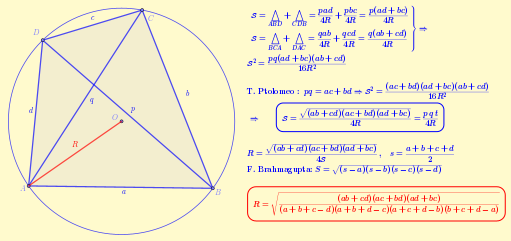
This GeoGebra example demonstrates how a cyclic quadrilateral’s circumradius and area can be determined as functions of its four side lengths, with the results dynamically reflected on the constructed diagram. It centers on the key ideas of cyclic quadrilaterals, circumcircles (circumradius), and angle relations for points on a common circle (using computed interior angles to support the necessary geometric constraints). The construction uses Intersect, Circle, Point, CircleArc, Polygon, InteriorAngles, and Segment to build the circumcircle and the quadrilateral, mark key arcs, and obtain the interior angles that drive the area computation. Named objects such as the circumcenter O, the circle objects c1/c_{2}, vertices A/B/C/D, and auxiliary construction elements (e.g., g, h) are combined with parameter variables (α, β, γ, δ) and output text objects (texto1, R) to present the circumradius and area. Suitable for advanced secondary school and early university geometry instruction, especially for dynamic verification of relationships and formula-based problem solving.
GeoGebra Commands & Parameters
Intersect(xAxis, yAxis) → OCircle(O, 1) → c_{2}Point(c_{2}) → APoint(c_{2}) → BCircleArc(O, B, A) → gPoint(g) → CCircleArc(O, C, A) → hPoint(h) → DPolygon(A, B, C, D) → c1, a, b, c, dInteriorAngles(c1) → α, β, γ, δSegment(A, C) → qSegment(D, B) → pSegment(O, A) → R
AI Drawing Prompt Reference
Draw a plane figure with the origin chosen as the circumcenter. Construct a circle centered at the origin with radius 1, then pick two points on this circle as vertices A and B. Using circle arcs with the same center, construct an arc from B to A and take its point as C, and construct an arc from C to A and take its point as D, forming the cyclic quadrilateral A-B-C-D on the circle. Show the quadrilateral edges, mark the corresponding interior angles determined by the four points on the circle (α, β, γ, δ), draw diagonals AC and DB, and finally draw the segment from the center to A as the radius R.
The prompt above was compiled from the original drawing commands and is for reference only.