
Cosine Rule & Pythagoras' Theorem Demo
Loading the math board and drawing, please wait…
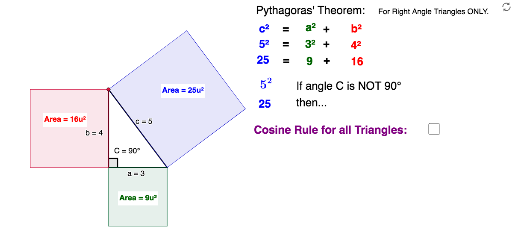
This example demonstrates the application of the Cosine Rule and Pythagoras' Theorem in calculating side lengths and angles within a triangle. Key math concepts include the Cosine Rule, Pythagorean Theorem, and triangle geometry properties. It is constructed using GeoGebra commands/objects like Segment, Point, Angle, Polygon, OrthogonalLine, Intersect, PointIn, and Length. Suitable for high school mathematics teaching or self-study to understand and apply trigonometric functions and geometric theorems.
GeoGebra Commands & Parameters
Segment(A, B) → aPoint(c_3) → C_1Segment(C_1, A) → bAngle(C_1, A, B) → CSegment(C_1, B) → cPolygon(A, E, D, B) → poly1, a_1, e, d_1, b_1OrthogonalLine(C_1, b) → iOrthogonalLine(A, b) → jIntersect(c_3, j) → F, GOrthogonalLine(F, j) → fIntersect(i, f) → HPolygon(H, F, A, C_1) → poly2, h, f_2, a_2, c_1PointIn(poly2) → Pointpoly2OrthogonalLine(C_1, c) → gOrthogonalLine(B, c) → kLength(c) → lIntersect(p, k) → I, JOrthogonalLine(J, k) → mIntersect(g, m) → KPolygon(K, C_1, B, J) → poly3, k_1, c_2, b_2, j_1PointIn(poly3) → Pointpoly3PointIn(poly1) → Pointpoly1Segment(A_1, B_1) → a_3Point(c_4) → C_2Segment(C_2, A_1) → b_3Angle(C_2, A_1, B_1) → C_3Segment(C_2, B_1) → c_5OrthogonalLine(C_2, c_5) → g_1OrthogonalLine(B_1, c_5) → k_2Length(c_5) → l_1Point(c_6) → C_4Segment(C_4, B_2) → c_7OrthogonalLine(C_4, c_7) → g_2OrthogonalLine(B_2, c_7) → k_3Length(c_7) → l_2Segment(A_2, B_3) → a_4Point(c_8) → C_5Segment(C_5, A_2) → b_4Angle(C_5, A_2, B_3) → C_6Segment(C_5, B_3) → c_9