
Constructing a Golden Section Rectangle
Loading the math board and drawing, please wait…
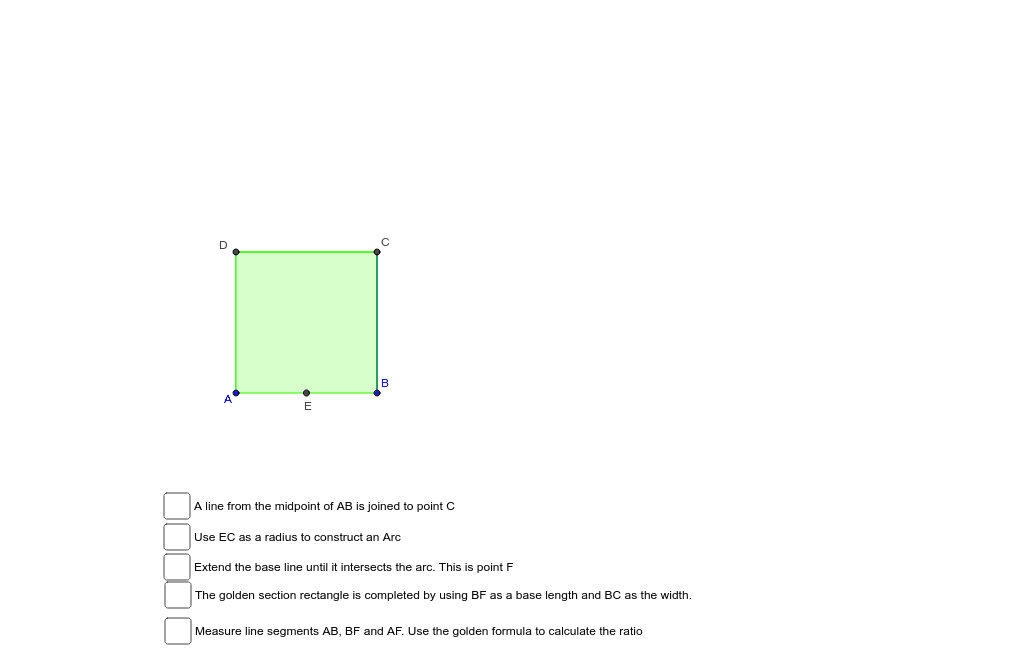
This example demonstrates how to construct a golden section rectangle. The golden section is a special ratio where the longer part of a line segment is to the shorter part as the whole segment is to the longer part. Key mathematical concepts include proportion, geometric construction, and the golden ratio. Using GeoGebra commands such as Polygon, Midpoint, and Circle, the construction process is visually illustrated. Suitable for middle school and above students to learn about geometry and proportions.
GeoGebra Commands & Parameters
Polygon(A, B, 4) → poly1, a, b, c, d, C, DMidpoint(a) → ECircle(E, Segment[E, C]) → ePoint(e) → F_1Ray(C, G_1) → hPoint(h) → HSegment(C, H) → lSegment(E, C) → mRay(A, B) → fIntersect(e, f, 1) → FSegment(A, F) → gRay(D, C) → iPoint(i) → GSegment(F, G) → j_1Segment(G, D) → kPolygon(C, G, F, B) → poly2, c_1, g_1, f_1, b_1Segment(C, G) → rPolygon(D, A, F, G) → poly3, d_1, j, f_2, g_2
AI Drawing Prompt Reference
Draw a square, find the midpoint of one side, and draw a circle with the midpoint as the center and the radius equal to the line segment from the midpoint to one vertex of the square. The circle intersects the other two sides of the square at two points. Connect these two points and extend the line, which intersects the opposite side of the square at a point. Connect this point to the opposite vertex of the square, and then connect this point to the other diagonal vertex. Finally, connect these four points to form a golden section rectangle.
The prompt above was compiled from the original drawing commands and is for reference only.