
Construct and Prove ABCD Is a Parallelogram
Loading the math board and drawing, please wait…
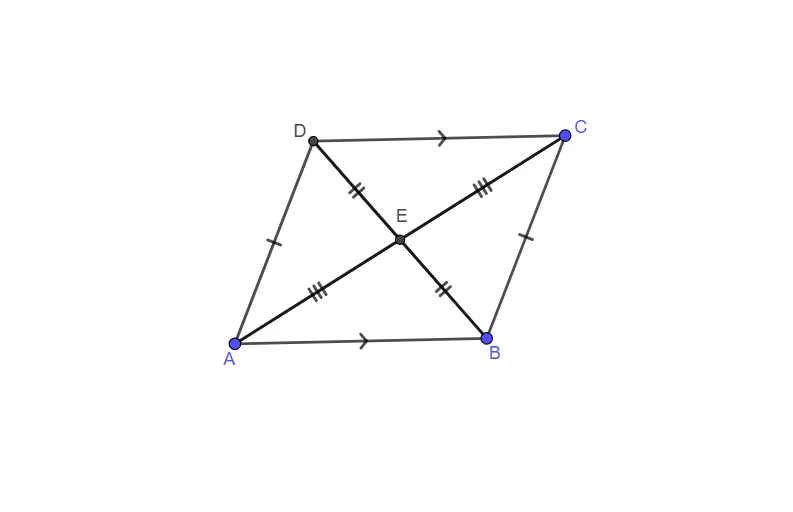
This example demonstrates a geometry-based task assessment that constructs and verifies whether quadrilateral ABCD is a parallelogram. It focuses on core parallelogram criteria such as parallel opposite sides and/or equal opposite side measures, using fundamental geometric entities (points, segments, and lines). The construction workflow leverages GeoGebra commands listed in the construction summary: Segment to create needed sides, Line to define supporting straight lines, and Intersect to obtain key intersection points that drive the logical relationships for the proof. The named objects (A, B, C, D plus auxiliary points and lines) indicate a structured build of both the main quadrilateral and helper constructions. Suitable for middle and high school geometry lessons, self-study on quadrilateral properties, and classroom demonstrations emphasizing proof through construction.
GeoGebra Commands & Parameters
Segment(A, B) → fLine(C, f) → gSegment(B, C) → hLine(A, h) → iIntersect(g, i) → DSegment(A, D) → kSegment(D, C) → jSegment(A, C) → lSegment(B, D) → mIntersect(l, m) → ESegment(A, E) → nSegment(E, C) → pSegment(B, E) → qSegment(E, D) → r
AI Drawing Prompt Reference
Draw a quadrilateral ABCD. Connect points A and B to form side f. Draw a line g through point C parallel to f. Connect points B and C to form side h. Draw a line i through point A parallel to h. Lines g and i intersect at point D. Connect points A and D to form side k. Connect points D and C to form side j. Connect points A and C to form side l. Connect points B and D to form side m. Sides l and m intersect at point E. Connect points A and E to form side n. Connect points E and C to form side p. Connect points B and E to form side q. Connect points E and D to form side r.
The prompt above was compiled from the original drawing commands and is for reference only.