
Comparing Fractions with Lines and Circles by Duane Habecker
Loading the math board and drawing, please wait…
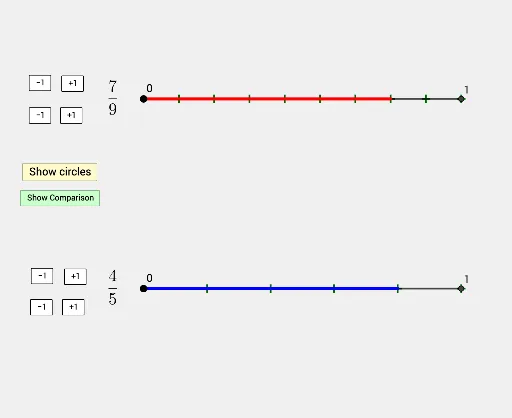
This example uses lines and circles to compare fractions. It demonstrates the basic concepts of fractions, including numerators and denominators. Using GeoGebra commands such as Line, Point, Circle, Intersect, etc., it constructs intuitive graphics to help understand the size relationship of fractions. Suitable for high-grade elementary and junior high school students.
GeoGebra Commands & Parameters
Line(A, yAxis) → fPoint(f) → BPoint(f) → CCircle(B, linelength) → cCircle(C, linelength) → dOrthogonalLine(B, f) → gOrthogonalLine(C, f) → hIntersect(c, g, 1) → DIntersect(d, h, 1) → ESegment(B, D) → iSegment(C, E) → jSequence(B + ((i * linelength / frac1denom), 0), i, 1, frac1denom) → frac1intervalsSequence(C + ((i * linelength / frac2denom), 0), i, 1, frac2denom) → frac2intervalsSegment(B, B + ((frac1num * linelength / frac1denom), 0)) → frac1segmentSegment(C, C + ((frac2num * linelength / frac2denom), 0)) → frac2segmentSegment(F, G) → kLine(H, f) → lPoint(l) → IPoint(l) → JCircle(I, circlesize) → eCircle(J, circlesize) → pIntersect(e, l, 2) → KIntersect(p, l, 2) → LSegment(I, K) → mSegment(J, L) → nSequence(Segment[Rotate[I, (i * angle1rotation), I], Rotate[K, (i * angle1rotation), I]], i, 1, frac1denom) → frac1wedgesSequence(Segment[Rotate[J, (i * angle2rotation), J], Rotate[L, (i * angle2rotation), J]], i, 1, frac2denom) → frac2wedgesCircleSector(I, K, Rotate[K, (frac1num * angle1rotation), I]) → frac1SectorCircleSector(J, L, Rotate[L, (frac2num * angle2rotation), J]) → frac2Sector