
Classifying Rational Numbers by Celia Jimenez
Loading the math board and drawing, please wait…
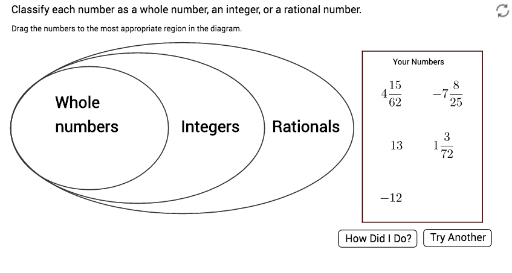
This example demonstrates the classification of rational numbers through graphical methods. It involves core mathematical concepts such as the definition and categorization of rational numbers, along with applications of probability and statistics. Key GeoGebra commands and objects used include Segment, Circle, Random, Sum, Text, and Polygon, which generate random numbers and visualize classification results. Suitable for high school mathematics education to help students understand rational number classification and probability statistics applications.
GeoGebra Commands & Parameters
Segment(center, point1) → SegRad1Circle(center, CircRad3) → circle3Circle(center, CircRad2) → circle2Circle(center, CircRad1) → circle1Random(0, 99) → RandNum1Random(0, 99) → RandNum2Random(1, 3) → diceroll1Circle(point1, 1) → HidePoint1Random(1, 9) → RandNum3Random(1, 2) → dicerollnegativeCircle(point2, 1) → HidePoint2Sum({count1, count2, count3, count4, count5}) → HelperFunction1Random(1, 3) → diceroll2Random(1, 3) → diceroll3Random(1, 3) → diceroll4Random(1, 3) → diceroll5Segment(center, point2) → SegRad2Segment(center, point3) → SegRad3Segment(center, point4) → SegRad4Segment(center, point5) → SegRad5Circle(point3, 1) → HidePoint3Circle(point4, 1) → HidePoint4Circle(point5, 1) → HidePoint5Circle(center, CircRad1) → circleshade1Circle(center, CircRad2) → circleshade2Circle(center, CircRad3) → circleshade3Circle((16, 2), 1.2) → startcircle2Circle((16, -1), 1.2) → startcircle3Circle((16, -4), 1.2) → startcircle4Circle((19, 2), 1.2) → startcircle1Circle((19, -1), 1.2) → startcircle5Text("Drag the numbers to the most appropriate region in the diagram.") → InstText("Your Numbers") → text4Polygon(A, B, C, D) → poly1, a, b, c, dText("Classify each number as a whole number, an integer, or a rational number.") → GenInstructions