
Circumcenter and Circumcircle Construction
Loading the math board and drawing, please wait…
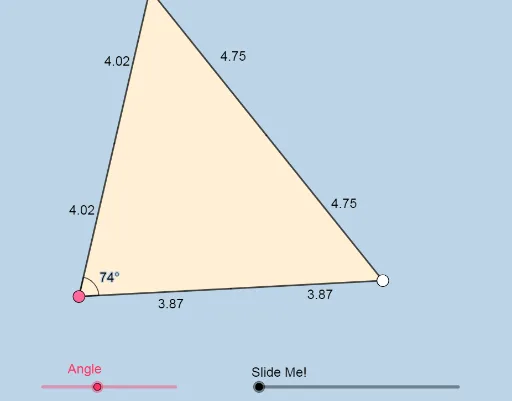
This applet dynamically demonstrates the construction of the circumcircle of a triangle. Key concepts include the circumcenter and circumcircle. Using commands like Rotate, Angle, Ray, Segment, students can understand the properties of the circumcircle. Suitable for middle school and above students for geometric construction.
GeoGebra Commands & Parameters
Rotate(B, (Angle * π / 180), A) → B'Angle(B, A, B') → αRay(A, B') → fSegment(A, B) → gPoint(f) → CPolygon(B, A, C) → t1, c, b, a_1Segment(A, C) → hSegment(C, B) → iMidpoint(g) → DMidpoint(i) → EMidpoint(h) → FOrthogonalLine(E, i) → jOrthogonalLine(D, g) → kOrthogonalLine(F, h) → lIntersect(j, k) → GDilate(A, If[0 < d ≤ 1, 1 - d, 0], D) → A'Segment(A, A') → mRotate(A, If[1 < d ≤ 2, ((-(d - 1)) * π), (-π)], D) → A'_1Segment(D, A'_1) → nDilate(B, If[2 < d ≤ 3, 3 - d, 0], E) → D'Segment(B, D') → pRotate(B, If[3 < d ≤ 4, ((-(d - 3)) * π), (-π)], E) → B'_1Segment(E, B'_1) → qDilate(C, If[4 < d ≤ 5, 5 - d, 0], F) → C'Segment(C, C') → rRotate(C, If[5 < d ≤ 6, ((-(d - 5)) * π), (-π)], F) → C'_1Segment(F, C'_1) → sDilate(D, If[6 < d ≤ 7, 7 - d, 0], G) → D'_1Segment(D, D'_1) → tAngle(G, D, A) → βDilate(E, If[7 < d ≤ 8, 8 - d, 0], G) → E'Segment(E, E') → ePoint(j) → HAngle(H, E, B) → γDilate(F, If[8 < d ≤ 9, 9 - d, 0], G) → F'Segment(F, F') → f_1Angle(G, F, C) → δDilate(G, If[10 < d ≤ 11, 11 - d, 0], C) → G'Segment(G, G') → g_1Angle(C, G, A) → εAngle(A, G, B) → ζRotate(G, If[11 < d ≤ 12, ((d - 11) * ε), ε], G) → G'_1Rotate(G', If[11 < d ≤ 12, ((d - 11) * ε), ε], G) → G''Segment(G'_1, G'') → h_1CircleArc(G, C, G'') → c_1Rotate(G'_1, If[12 < d ≤ 13, ((d - 12) * ζ), ζ], G) → IRotate(G'', If[12 < d ≤ 13, ((d - 12) * ζ), ζ], G) → G'''Segment(I, G''') → i_1CircleArc(G, A, G''') → d_1Rotate(I, If[13 < d ≤ 14, ((d - 13) * ((2 * π) - ε - ζ)), (2 * π) - ε - ζ], G) → I'Rotate(G''', If[13 < d ≤ 14, ((d - 13) * ((2 * π) - ε - ζ)), (2 * π) - ε - ζ], G) → JSegment(I', J) → j_1CircleArc(G, B, J) → e_1Segment(A, D) → aSegment(D, B) → k_1Segment(B, E) → l_1Segment(E, C) → m_1Segment(C, F) → n_1Segment(F, A) → p_1