
Centroid of a Triangle
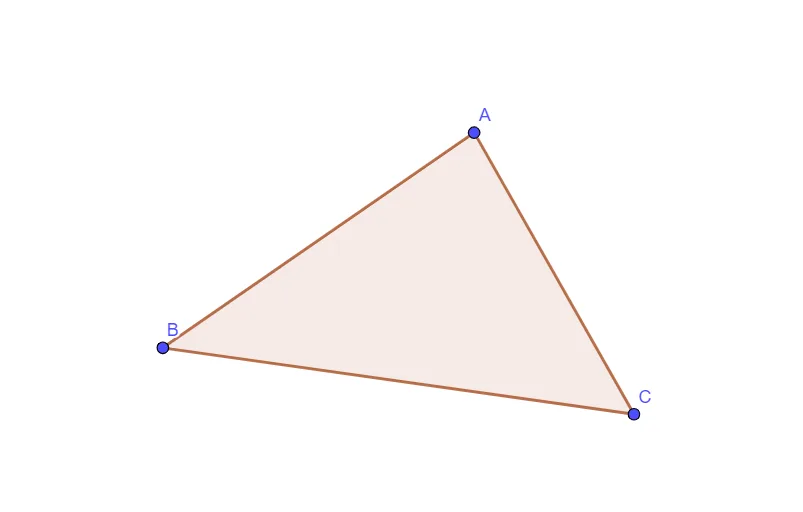
This example demonstrates the geometric properties of a triangle's centroid. The centroid is the intersection point of the triangle's three medians and serves as its physical center of mass. Constructed using the Polygon command, it visually illustrates the centroid's position and its geometric relationships with the vertices and sides, aiding learners in understanding core concepts in plane geometry.
Users can interact with the applet by dragging any of the three vertices to reshape the triangle dynamically. As the triangle changes form, the medians and the centroid adjust in real time, reinforcing the invariant nature of this geometric point. Each median connects a vertex to the midpoint of the opposite side, and the applet clearly shows that all three medians always converge at a single point—the centroid.
The construction process begins by defining three non-collinear points with the Polygon tool, which forms triangle ABC. Midpoints of each side are then determined, and line segments are drawn from each vertex through its opposite midpoint. The point of concurrency where these three medians meet is highlighted as the centroid, typically labeled G. The applet may also display the two-thirds and one-third segment ratio property: the centroid divides each median into a 2:1 ratio, with the longer portion connecting the vertex to the centroid and the shorter portion connecting the centroid to the midpoint of the opposite side. This relationship can be verified interactively by measuring distances or enabling dynamic segment displays.
From a physical standpoint, the centroid represents the balance point or center of gravity of a uniform triangular lamina. If the triangle were cut from a thin, homogeneous sheet of material, it would balance perfectly on a pin placed at the centroid. This connection between abstract geometry and tangible physics helps students see the practical significance of the concept beyond pure mathematics.
Educational benefits include strengthened intuition about concurrency, median properties, and the interplay between algebraic reasoning and geometric visualization. Students who manipulate the triangle directly develop a deeper, more experiential grasp of why the centroid always lies inside the triangle, regardless of whether the triangle is acute, right, or obtuse. The interactive nature of the applet encourages exploration, hypothesis testing, and discovery-based learning, making it a valuable tool for both classroom instruction and independent study in introductory geometry courses.
In collections
Triangle Centers: Interactive Geometry
Loading the math board and drawing, please wait…