
Cavalieri's Principle - Volume of a Sphere
Loading the math board and drawing, please wait…
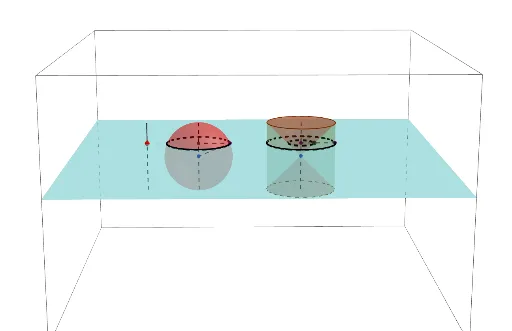
This example demonstrates the calculation of a sphere's volume using Cavalieri's principle by comparing cross-sectional areas of a cylinder, cone, and sphere. Core mathematical concepts include volume calculation, geometric cross-sections, Cavalieri's principle, and analytical geometry. Construction highlights from the summary involve commands like Sphere, Cylinder, Cone, Segment, Point, OrthogonalPlane, IntersectPath, Corner, Intersect, Line, and Circle. Suitable for high school geometry and calculus students to visually understand volume calculation principles.
GeoGebra Commands & Parameters
Sphere(A, B) → aCylinder(C, D, 2) → b, c, d, eCone(D, E, 2) → f, g, hCone(C, E, 2) → i, k, jSegment(G, F) → lPoint(l) → HOrthogonalPlane(H, l) → mIntersectPath(m, a) → pIntersectPath(m, b) → qCorner(q) → M, N, O, PIntersectPath(m, i) → rIntersectPath(m, f) → sCorner(s) → I, J, K, LSegment(C, D) → nSegment(Q, B) → tIntersect(t, m) → RIntersect(n, m) → SLine(H, S) → a_1Intersect(a_1, p) → T, USegment(R, T) → b_1Segment(R, A) → c_1Segment(A, T) → d_1Intersect(a_1, q) → V, WIntersect(a_1, r) → Z, A_1Segment(Z, E) → e_1Segment(E, S) → f_1Segment(S, V) → g_1Circle(c_1, T) → h_1Circle(f_1, V) → k_1Intersect(g_1, r) → B_1,Circle(n, B_1) → p_1