
Calculator
Loading the math board and drawing, please wait…
In collections
Rechnen mit Potenzen
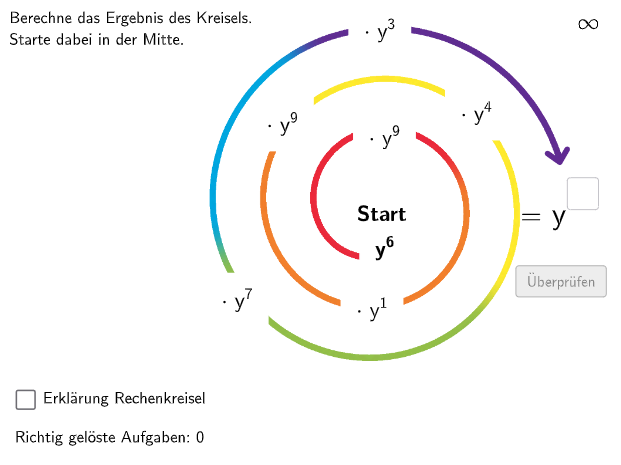
This GeoGebra example demonstrates the working of a calculator, showing how to use exponents and operation rules to calculate numbers. The core math concepts involved are exponents, operation rules, and number calculation. The construction points include using Textfield, Shuffle, If, and other GeoGebra commands and objects. It is suitable for middle school math education, particularly for 7-8 grade students.
GeoGebra Commands & Parameters
Textfield(input1) → InputBox1Textfield(input2) → InputBox2Shuffle({1, 2, 3, 4, 5, 6, 7, 8, 9}) → Expo1List, {6, 7, 1, 2, 4, 3, 9, 5, 8}Shuffle({1, If[expo1 > 1, -1, 1]}) → Expo2OPList, {1, -1}If(expo2op ≟ 1, Shuffle[{1, 2, 3, 4, 5, 6, 7, 8, 9} \ {expo1}], Shuffle[Sequence[i, i, 1, expo1 - 1]]) → Expo2ListShuffle({1, If[expo1 + (expo2op * expo2) > 1, -1, 1]}) → Expo3OPList, {1, -1}If(expo3op ≟ 1, Shuffle[{1, 2, 3, 4, 5, 6, 7, 8, 9} \ {expo2}], Shuffle[Sequence[i, i, 1, Min[expo1 + (expo2op * expo2) - 1, 9]]]) → Expo3ListShuffle({1, If[expo1 + (expo2op * expo2) + (expo3op * expo3) > 1, -1, 1]}) → Expo4OPList, {1, -1}If(expo4op ≟ 1, Shuffle[{1, 2, 3, 4, 5, 6, 7, 8, 9} \ {expo3}], Shuffle[Sequence[i, i, 1, Min[expo1 + (expo2op * expo2) + (expo3op * expo3) - 1, 9]]]) → Expo4ListShuffle({1, If[expo1 + (expo2op * expo2) + (expo3op * expo3) + (expo4op * expo4) > 1, -1, 1]}) → Expo5OPList, {1, -1}If(expo5op ≟ 1, Shuffle[{1, 2, 3, 4, 5, 6, 7, 8, 9} \ {expo4}], Shuffle[Sequence[i, i, 1, Min[expo1 + (expo2op * expo2) + (expo3op * expo3) + (expo4op * expo4) - 1, 9]]]) → Expo5ListShuffle({1, If[expo1 + (expo2op * expo2) + (expo3op * expo3) + (expo4op * expo4) + (expo5op * expo5) > 1, -1, 1]}) → Expo6OPList, {1, -1}If(expo6op ≟ 1, Shuffle[{1, 2, 3, 4, 5, 6, 7, 8, 9} \ {expo5}], Shuffle[Sequence[i, i, 1, Min[expo1 + (expo2op * expo2) + (expo3op * expo3) + (expo4op * expo4) + (expo5op * expo5) - 1, 9]]]) → Expo6ListShuffle({1, If[expo1 + (expo2op * expo2) + (expo3op * expo3) + (expo4op * expo4) + (expo5op * expo5) + (expo6op * expo6) > 1, -1, 1]}) → Expo7OPList, {1, -1}If(expo7op ≟ 1, Shuffle[{1, 2, 3, 4, 5, 6, 7, 8, 9} \ {expo6}], Shuffle[Sequence[i, i, 1, Min[expo1 + (expo2op * expo2) + (expo3op * expo3) + (expo4op * expo4) + (expo5op * expo5) + (expo6op * expo6) - 1, 9]]]) → Expo7ListPolygon(PtopLeftCornerFeedback, PtopRightCornerFeedback, PbottomRightCornerFeedback, PbottomLeftCornerFeedback) → rectangleCorrect, rectangleCorrectS3, rectangleCorrectS4, rectangleCorrectS2, rectangleCorrectS1Shuffle(Sequence[Random[0, 10], i, 1, 100]) → randomNosForX, {3, 1, 10, 9, 4, 6, 1, 7, 9, 2, 0, 3, 5, 4, 0, 4, 4, 10, 10, 5, 7, 4, 8, 3, 0, 2, 4, 2, 8, 0, 5, 3, 8, 4, 10, 4, 2, 8, 5, 7, 8, 10, 7, 5, 10, 4, 0, 2, 0, 8, 7, 7, 2, 8, 5, 1, 7, 4, 8, 0, 4, 3, 2, 5, 4, 1, 6, 4, 4, 9, 4, 10, 5, 9, 2, 7, 3, 5, 3, 1, 8, 5, 3, 6, 3, 10, 8, 10, 6, 2, 2, 2, 3, 5, 3, 7, 0, 3, 10, 9}Element(randomNosForX, Mod[questionCount, 100] + 1) → numXShuffle(Sequence[Random[0, 10], i, 1, 100]) → randomNosForY, {9, 10, 4, 9, 4, 0, 4, 2, 6, 8, 7, 8, 5, 2, 2, 3, 7, 0, 3, 9, 2, 3, 9, 4, 1, 0, 2, 2, 2, 1, 1, 9, 9, 8, 6, 7, 10, 8, 4, 4, 6, 6, 5, 2, 10, 7, 8, 8, 3, 4, 1, 4, 6, 1, 1, 5, 9, 9, 10, 7, 2, 3, 5, 8, 3, 0, 7, 7, 9, 3, 6, 6, 2, 9, 3, 2, 7, 6, 1, 10, 1, 4, 3, 3, 1, 0, 7, 8, 1, 1, 2, 5, 9, 5, 4, 8, 1, 8, 0, 8}Element(randomNosForY, Mod[questionCount, 100] + 1) → numYAppend(true, Sequence[If[randomNosForX(i) ≟ randomNosForX(i - 1), false, true], i, 2, 100]) → stayXAppend(true, Sequence[If[randomNosForY(i) ≟ randomNosForY(i - 1), false, true], i, 2, 100]) → stayYRemove(Sequence[If[stayX(i), randomNosForX(i), 0], i, 1, 100], Sequence[0, i, 1, 100]) → randomNosForXwithoutRepeatRemove(Sequence[If[stayY(i), randomNosForY(i), 0], i, 1, 100], Sequence[0, i, 1, 100]) → randomNosForYwithoutRepeatElement(randomNosForXwithoutRepeat, Mod[questionCount, Length[randomNosForXwithoutRepeat]] + 1) → numXwithoutRepeatElement(randomNosForYwithoutRepeat, Mod[questionCount, Length[randomNosForYwithoutRepeat]] + 1) → numYwithoutRepeatDefined(input1) → fixedShuffle({"a", "b", "c", "d", "g", "h", "k", "m", "n", "r", "s", "t", "u", "v", "w", "x", "y", "z"}) → VarList, {"y", "h", "u", "g", "t", "n", "w", "c", "m", "r", "d", "b", "s", "v", "k", "a", "z", "x"}
AI Drawing Prompt Reference
Draw an interactive calculator interface with two input boxes for entering numbers. Randomly generate a mathematical expression consisting of several exponential terms, each with a base and an exponent, where exponents may have positive or negative signs, and the overall result must be greater than 1. Below the expression, show a rectangular area for feedback on whether the answer is correct. Scatter random digit points in the background for visual decoration. The whole graphic should illustrate exponent operations and operation rules for middle school students.
The prompt above was compiled from the original drawing commands and is for reference only.