
Bertrand Paradox - First Method
Loading the math board and drawing, please wait…
In collections
probability
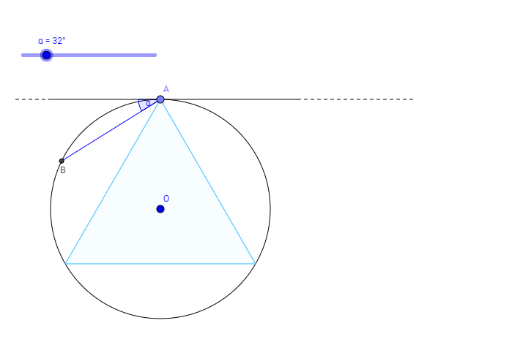
This example illustrates the first solution to Bertrand's paradox. It involves probability and geometric construction. Using GeoGebra commands such as Circle, Point, Tangent, Rotate, etc., a circle and a random point within it are constructed to explore the results under different probability models. Suitable for high school mathematics education and students learning probability and statistics.
GeoGebra Commands & Parameters
Circle(O, 3) → cPoint(c) → ATangent(A, c) → tangentLine,Point(tangentLine) → B_1Rotate(B_1, α, A) → B'Angle(B_1, A, B') → βRotate(B_1, 60°, A) → B'_1Angle(B_1, A, B'_1) → γLine(A, B'_1) → eIntersect(c, e, 2) → DPolygon(A, D, 3) → poly1, f, g, h, ELine(A, B') → line_{AB}Intersect(c, line_{AB}, 2) → BSegment(A, B) → seg_{AB}Line(A, O) → diamLineIntersect(c, diamLine, 2) → CSegment(A, C) → diamCircle(A, (m * diam)) → MConicIntersect(MConic, diam, 1) → M_{PQ}OrthogonalLine(M_{PQ}, diam) → perpToDiamLineIntersect(c, perpToDiamLine, 2) → QIntersect(c, perpToDiamLine, 1) → PSegment(P, Q) → seg_{PQ}Rotate(A, 30°, C) → A'Angle(A, C, A') → δLine(C, A') → iIntersect(c, i, 2) → FPolygon(F, C, 3) → poly2, j, k, l, GCircle(O, (0.25 * diam)) → dSegment(M_{ST}, O) → seg_{OMST}OrthogonalLine(M_{ST}, seg_{OMST}) → line_{ST}Intersect(c, line_{ST}, 1) → SIntersect(c, line_{ST}, 2) → TSegment(S, T) → seg_{ST}Point(tangentLine) → HPoint(tangentLine) → IPoint(tangentLine) → JPoint(tangentLine) → KSegment(I, K) → nSegment(K, A) → pSegment(A, H) → qSegment(H, J) → r
AI Drawing Prompt Reference
Draw a circle with radius 3 centered at O. Randomly select a point A inside the circle and draw a tangent line at A. Choose two points B1 and B' on the tangent line. Rotate B' to get B'1 and calculate the angles β and γ between B1, A, and B'1. Draw a line e through A and B'1, intersecting the circle at D to form a triangle. Then, draw a line through A and B, intersecting the circle at B. Draw the diameter AC, intersecting the circle at C. Construct a circle M with center A and diameter AC, intersecting the diameter at M_{PQ}. Draw a perpendicular line to M_{PQ} and intersect the circle at P and Q, then connect P and Q. Rotate A to get A', calculate the angle δ between A, C, and A', and draw a line i through C and A', intersecting the circle at F to form another triangle. Construct a circle d with center O and radius half the diameter, intersecting the diameter at M_{ST}. Draw a perpendicular line to M_{ST} and intersect the circle at S and T, then connect S and T. Finally, select four points I, J, K, and H on the tangent line and connect them.
The prompt above was compiled from the original drawing commands and is for reference only.